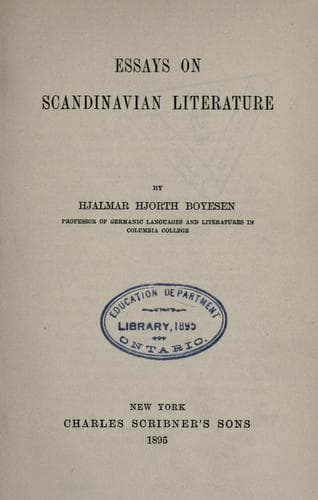
Essays on Scandinavian LiteratureBoyesen, Hjalmar Hjorth
History
Essays on Scandinavian Literature
Boyesen, Hjalmar Hjorth
Authors, Scandinavian; Scandinavian literature -- History and criticism
excess in that direction does not trouble us.
[22] For verification of this statement I may refer to his indignant
letter _a propos_ of the statue that was to be raised to him in
Copenhagen, in which he was represented surrounded by listening
children: "None of the sculptors," he wrote, "have known me; none of
their sketches indicate that they have seen what is characteristic
in me. Never could I read aloud when anybody was sitting behind me
or close up to me; far less if I had children on my lap or on my
back, or young Copenhageners lying all over me. It is a _facon de
parler_ to call me 'the children's poet.' My aim has been to be the
poet of all ages; children could not represent me."
In 1842 Andersen gave to the world "A Poets' Bazaar," a chronicle of his
travels through nearly all the countries of Europe. In 1844 the drama
"The King is Dreaming," and in 1845 the fairy comedy "The Flower of
Fortune." But his highest dramatic triumph he celebrated in the
anonymous comedy "The New Lying-in Room," which in a measure proved his
contention that it was personal hostility and not critical scruples
which made so large a portion of the Copenhagen literati persecute him.
For the very men who would have been the first to hold his play up to
scorn were the heartiest in their applause, as long as they did not know
that Andersen was its author. Less pronounced was the success of the
lyrical drama "Little Kirsten" (1846); and the somewhat ambitious epic
"Ahasverus" comes very near being a failure. The next ventures of the
versatile and indefatigable poet were the novel "The Two Baronesses"
(1849), and the fairy comedies "More than Pearls and Gold" (1849),
adapted from a German original, "The Sandman"[23] (1850), and "The Elder
Tree Mother" (1851). The comedies "He was not Born" (1864), "On
Langebro" and "When the Spaniards were Here" (1869), complete the cycle
of his dramatic labors. But the most amusing thing he did, showing how
incapable he was of taking the measure of his faculties, was to write a
novel, "To Be or Not to Be" (1857), in which he proposed once and
forever to down the giant Unbelief, prove the immortality of the soul,
and produce "peace and reconciliation between Nature and the Bible." It
was nothing less than the evidences of Christianity in novelistic form
with which he designed to favor an expectant world. "If[24] I can solve
this problem," he naively wrote to a friend, "then the monster
materialism, devouring everything divine, will die." But rarely was a
bigger Gulliver tackled by a tinier Liliputian. The book not only fell
flat, but it was only the world-wide renown and the good intention of
its author which saved it from derision.
[23] Danish, Ole Lukoeie.
[24] Hansen: Illustreret Dansk Litteratur Historie, ii. p. 560.
Public-domain text, read in full here on John Shaqi.
Reviews
Reviews
No reviews yet
Be the first to share your thoughts on this work.
Elsewhere in the archive
Join the Discussion
Join the discussion
Sign in to leave a comment or review.
Sign InorCreate an account