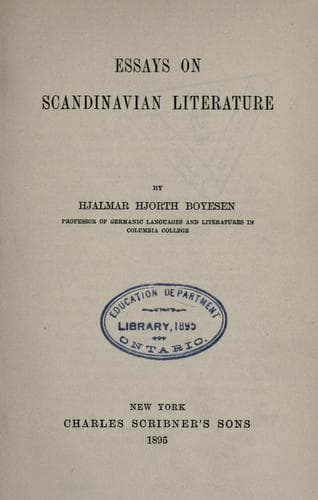
Essays on Scandinavian LiteratureBoyesen, Hjalmar Hjorth
History
Essays on Scandinavian Literature
Boyesen, Hjalmar Hjorth
Authors, Scandinavian; Scandinavian literature -- History and criticism
Widely different as these three men are in almost everything, they have
this in common, that they have deeply breathed the air of the nineteenth
century; and they all show more or less the influence of Brandes. That
this influence has been direct and personal seems probable from the
relation which they have sustained to the revolutionary critics. Of this
I am, however, by no means sure. Mr. Jacobsen, who was by profession a
botanist, and translated Darwin into Danish, no doubt came by his
"advanced views" at first hand. In the case of Schandorph it is more
difficult to judge. He is an excellent linguist, and may have had access
to the same sources from which Brandes drew his strength. Drachmann is
so vacillating in his tendencies that he refuses to be permanently
classified in any school of art or thought. Of the three, Schandorph
seems altogether the maturest mind and furnishes the most finished and
satisfactory work. In his novel "Without a Centre" (_Uden Midtpunkt_)
the reader feels himself at once face to face with an interesting and
considerable personality. He has that sense of surprise and delighted
expectation which only the masters of fiction are apt to evoke. It is a
story of a Danish national type--the conversational artist. In no
country in the world is there such a conversational fury as in Denmark.
A people has, of course, to do something with its surplus energy; and as
political opposition is sure to prove futile, there is nothing left to
do but to talk--not only politics, but art, poetry, religion, in fact,
everything under the sun. At the time, however, when Albrecht, the hero
of "Without a Centre," plied his nimble tongue, the country had a more
liberal Government, and criticism of the Ministry was not yet high
treason. But centuries of repression and the practical exclusion of the
bourgeoisie from public life were undoubtedly the fundamental causes of
this abnormal conversational activity. There is something soft and
emotional in the character of the Danes, which distinguishes them from
their Norwegian and Swedish kinsmen--an easily flowing lyrical vein,
which imparts a winning warmth and cordiality to their demeanor.
Socially they are the most charming people in the world. Also in this
respect Albrecht is typical, and the songs in which he gives vent to his
lyrical moods have such a rapturous melody that they keep humming in the
brain long after the reader has closed the book. It almost follows as a
psychological necessity that a man so richly endowed with the gift of
speech is feeble and halting in action. Like Tourgueneff's "Rudin," who
suffered from the same malady, he gains by the brilliancy and novelty of
his speech the love of a noble young girl, who, taking his phrases at
their face value, believes his heart to be as heroic as his tongue.
Like him, too, he fails in the critical moment; nay, restrained by petty
scruples, he even stays away from the rendezvous, and by his cowardice
Public-domain text, read in full here on John Shaqi.
Reviews
Reviews
No reviews yet
Be the first to share your thoughts on this work.
Elsewhere in the archive
Join the Discussion
Join the discussion
Sign in to leave a comment or review.
Sign InorCreate an account