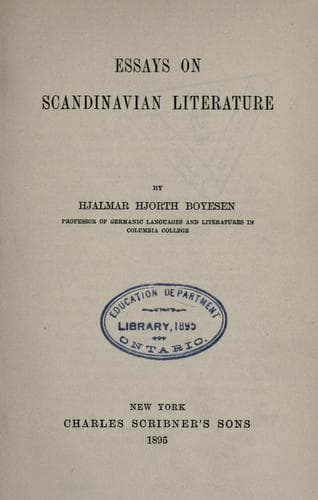
Essays on Scandinavian LiteratureBoyesen, Hjalmar Hjorth
History
Essays on Scandinavian Literature
Boyesen, Hjalmar Hjorth
Authors, Scandinavian; Scandinavian literature -- History and criticism
In Jacobsen's third book, "Niels Lyhne," we have again the story of a
Danish Rudin--a nature with a multitude of scattered aspirations,
squandering itself in brilliant talk and fantastic yearnings. It is the
same coquetting with the "advanced" ideas of the age, the same lack of
mental stamina, the same wretched surrender and failure. It is the
complexion of a period which the author is here attempting to give, and
he takes pains to emphasize its typical character. One is almost tempted
to believe that Shakespeare, by a gift of happy divination, made his
Prince of Denmark conform to this national type, though in his day it
could not have been half as pronounced as it is now. Whether the Dane of
the sixteenth century was yet the eloquent mollusk which we are
perpetually encountering in modern Danish fiction is a question which,
at this distance, it is hard to decide. The type, of course, is
universal, and is to be found in all countries. Only in the English
race, on both sides of the Atlantic, it is comparatively rare. That a
vigorous race like the Danish, confined, as it is in modern times,
within a narrow arena of action (and forbidden to do anything on that),
should have developed it to a rare perfection seems, as I have already
remarked, almost a psychological necessity.
Holger Drachmann, in his capacity of lyrist, has also a strain of the
Hamlet nature; although, in the case of a poet, whose verses are in
themselves deeds, the assertion contains no reproach. I am not even sure
that the Protean quality of Drachmann's verse--its frequent voicing of
naturally conflicting tendencies--need be a matter of reproach. A poet
has the right to sing in any key in which he can sing well; and
Drachmann sings, as a rule, exceedingly well. But, like most people with
a fine voice, he is tempted to sing too much; and it thus happens that
verses of slipshod and hasty workmanship are to be found in his volumes.
In his first book of "Poems" he was a free oppositional lance, who
carried on a melodious warfare against antiquated institutions and
opinions, and gave a thrust here and a thrust there in behalf of
socialists, communists, and all sorts of irregular characters. Since
that time his radical, revolutionary sympathies have had time to cool,
and in each succeeding volume he has appeared more sedate, conservative,
_bourgeois_.[25] In a later volume of poems this transformation is half
symbolically indicated in the title, "Tempered Melodies." Nor is it to
be denied that his melodies have gained in beauty by this process of
tempering. There is a wider range of feeling, greater charm of
expression, and a deeper resonance. Half a dozen volumes of verse which
he has published since ("Songs of the Ocean," "Venezia," "Vines and
Roses," "Youth in Verse and Song," "Peder Tordenskjold," "Deep Chords")
are of very unequal worth, but establish beyond question their author's
right to be named among the few genuine poets of the latter half of the
Public-domain text, read in full here on John Shaqi.
Reviews
Reviews
No reviews yet
Be the first to share your thoughts on this work.
Elsewhere in the archive
Join the Discussion
Join the discussion
Sign in to leave a comment or review.
Sign InorCreate an account