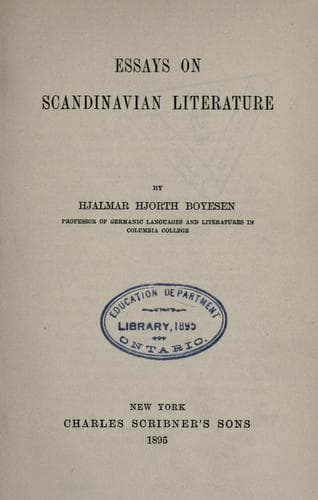
Essays on Scandinavian LiteratureBoyesen, Hjalmar Hjorth
History
Essays on Scandinavian Literature
Boyesen, Hjalmar Hjorth
Authors, Scandinavian; Scandinavian literature -- History and criticism
It is a matter of wonder that a man in whom the race-type had reached
such perfection was but two generations removed from the soil. Tegner's
grandfathers on both sides were peasants; and his father, Esaias
Lucasson, was a peasant lad who by industry and ambition had obtained an
education and become a clergyman. He owed his aristocratic name to the
custom, prevalent in those days, to Latinize all vulgar appellations.
Esaias Lucasson, of Tegnaby (the little Smaland village where he was
born), became, in the Latin school, Esaias Tegnerus. He married in the
course of time a clergyman's daughter, Sara Maria Seidelius, who bore
him a large family of sons and daughters. The fifth son, named Esaias
after his father, first saw the light of day in the parsonage of
Kyrkerud, in Wermland, November 13, 1782. When he was nine years old his
father died, leaving behind him poverty and sorrow. Happily a friend of
the family, the Assessor Branting, took a fancy to the handsome and
clever boy and offered him a home in his house. Esaias wrote a very
clear, good hand, and soon got a desk and a high three-legged stool in
the assessor's office. So far from rebelling against this tedious
discipline, he applied himself with zeal to his task, and became, in a
short time, an excellent clerk. And a clerk he might have remained if
his patron had not had the wit to discover that very unusual talents
slumbered in the lad. Being fond of his society, Mr. Branting got into
the habit of taking him along on his official journeys; and from the
back seat of his chaise Esaias made the acquaintance of the beautiful
rivers, heights, and valleys of Wermland. The unconscious impressions
which a boy absorbs at this period of his life are apt to play a
decisive part in fashioning his future. Nature, however picturesque,
never yet made a poet of a dullard; but many a time has she aroused to
poetic consciousness a soul which without this stimulating influence
might never have discovered its calling, might never have felt that
strange, tremulous exaltation which demands utterance in song.
Public-domain text, read in full here on John Shaqi.
Reviews
Reviews
No reviews yet
Be the first to share your thoughts on this work.
Elsewhere in the archive
Join the Discussion
Join the discussion
Sign in to leave a comment or review.
Sign InorCreate an account