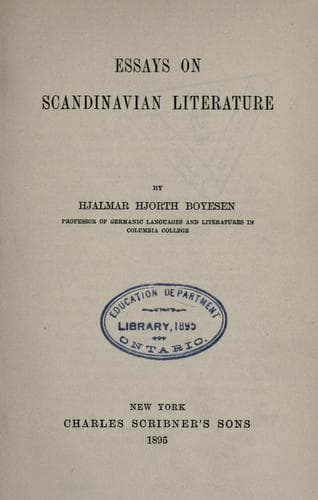
Essays on Scandinavian LiteratureBoyesen, Hjalmar Hjorth
History
Essays on Scandinavian Literature
Boyesen, Hjalmar Hjorth
Authors, Scandinavian; Scandinavian literature -- History and criticism
It is with no desire to disparage Tegner that I say that this strain,
which is that of all his early war-songs, is extremely becoming to him.
It is not a question of the legitimacy of the sentiment, but of the
fulness and felicity of its expression. As long as we have wars we must
have martial bards, and with the exception of the German, Theodor
Koerner, I know none who can bear comparison with Tegner. English
literature can certainly boast no war-poem which would not be drowned in
the mighty music of Tegner's "Svea," "The Scanian Reserves," and that
magnificent, dithyrambic declamation, "King Charles, the Young Hero."
Tennyson's "Charge of the Light Brigade" is technically a finer poem
than anything Tegner has written, but it lacks the deep virile bass, the
tremendous volume of breath and voice, and the captivating martial lilt
which makes the heart beat willy nilly to the rhythm of the verse.
The popularity which Tegner gained by "The Scanian Reserves" was the
immediate cause of his appointment to a professorship at the University
of Lund, and his next notable poem, "Svea," which won him the great
prize of the Swedish Academy, raised him to a height of fame which
naturally led to further promotion. According to the curious custom of
Sweden, a professor may, even though he has never studied theology, take
orders and accept the charge of a parish. He is regarded as being, by
dint of his learning, in the regular line of clerical promotion; and the
elevation from a professorship (though it be not a theological one) into
a bishopric is no infrequent occurrence. There was therefore nothing
anomalous in Tegner's appointment (February, 1812) as pastor of Staefvie
and Lackalaenge, and his subsequent promotion (February, 1824) to the
bishopric of Wexioe. His pastorate he was permitted to combine with his
professorship of Greek, to which he was simultaneously transferred from
that of aesthetics, and the office was chiefly valuable to him on account
of the addition which it procured him to his income. The nearness of his
parish to Lund enabled him to preach in the country on Sundays as
regularly as he lectured in the city on week-days. His other pastoral
duties he could not very well discharge _in absentia_, and they probably
remained in a measure undischarged. He had not sought the parish; it was
the parish which had sought him; and he exerted himself to the utmost to
fill the less congenial office as conscientiously as he did his academic
chair. The peasants of Staefvie and Lackalaenge were always welcome at his
hospitable board; he gave them freely his advice, and in order to recall
and emphasize his own kinship with them, he invited a peasant woman to
become the godmother of his youngest son, and selected all the sponsors
from the same class.
Public-domain text, read in full here on John Shaqi.
Reviews
Reviews
No reviews yet
Be the first to share your thoughts on this work.
Elsewhere in the archive
Join the Discussion
Join the discussion
Sign in to leave a comment or review.
Sign InorCreate an account