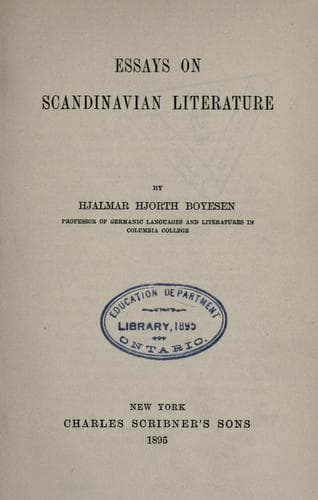
Essays on Scandinavian LiteratureBoyesen, Hjalmar Hjorth
History
Essays on Scandinavian Literature
Boyesen, Hjalmar Hjorth
Authors, Scandinavian; Scandinavian literature -- History and criticism
Restless official activity, parliamentary labors, educational addresses,
and metrical discourses on memorable occasions filled the years from
1829 to 1840. He felt the demon of insanity lurking behind him, now
close at his heels, now farther away; and it was a desperate race, in
which life and death, nay, worse than death, was at stake. His
indefatigable exertions afforded him a respite from the thought of his
terrible pursuer. We can only regard with respectful compassion the
outbreaks of misanthropic spleen which often disfigure his
correspondence from this period of deepening twilight, relieved by a
brief interval of brightness. It is especially woman who is the object
of his bitterest objurgation. The venerable _mutabile et varium_ of
Virgil is the theme upon which he perpetually rings the changes. No
occasion is too inappropriate for a joke at the fickle and faithless
sex; and even the school-boys in the Wexioe gymnasium are treated to some
ironical advice, _a propos_ of the beautiful jade, which must have
sounded surprising in an episcopal oration. Life with its bright pageant
was oppressive, like a nightmare to the afflicted poet. All charm, all
rationality had departed from existence, which was but a meaningless
dance of hideous marionettes. The world was battered and befouled;
inexpressibly loathsome. And finally, in 1840, while Tegner was
attending the Riksdag (of which in his official capacity he was a
member), the long-dreaded catastrophe occurred. His insanity manifested
itself in tremendous projects of reform, world-conquests, and outbreaks
of wild sensuality. He was sent to a celebrated asylum in Sleswick; and
on the way thither wrote a series of "Fantasies of Travel" which have
all the rich harmony of his earlier verse, and are full of delightful
imagery. He fancied that there was a huge wheel of fire revolving with
furious haste in his head, and his sufferings were terrific. The
following fragment from the notes of his attendant, who kept a record of
his ravings, has a cosmic magnificence:
Public-domain text, read in full here on John Shaqi.
Reviews
Reviews
No reviews yet
Be the first to share your thoughts on this work.
Elsewhere in the archive
Join the Discussion
Join the discussion
Sign in to leave a comment or review.
Sign InorCreate an account