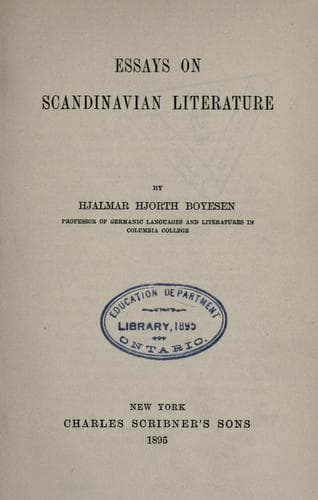
Essays on Scandinavian LiteratureBoyesen, Hjalmar Hjorth
History
Essays on Scandinavian Literature
Boyesen, Hjalmar Hjorth
Authors, Scandinavian; Scandinavian literature -- History and criticism
Contrary to the expectation of his friends he recovered rapidly, and was
able to return home in May, 1841. He promptly resumed his episcopal
functions, and even wrote a beautiful rural idyl in hexameters called
"The Crowned Bride" (_Kronbruden_), which he dedicated to Franzen. He
was well aware, however, that his powers were on the wane, and in 1845
he was persuaded to apply for a year's relief from his official duties.
The last months of his life he spent mostly lying upon a sofa in his
library, surrounded by great piles of books containing a most
miscellaneous assortment of classics, from Homer to Goethe,
intersprinkled with controversial pamphlets and recent novels. He was
gentle and affectionate in his demeanor; and his beautiful face lighted
up with a smile whenever any of his children or grandchildren approached
him. Once or twice a day he drove out in his carriage, and he was even
able to visit his eldest son, who was a clergyman in Scania, and to
receive the sacrament for the last time from his hand. Shortly after his
return he was stricken with paralysis, and died November 2, 1846, in the
sixty-fourth year of his age. His mind was unclouded and his voice was
clear. When the autumnal sun suddenly burst through the windows and
shone upon the dying poet, he murmured: "I will lift up mine hands unto
the house and the mountain of God."
These were his last words. He was carried to the grave at night by the
light of lanterns, followed by a long procession of the clergy,
citizens, and the school-boys of his diocese. Peasants, from whose ranks
he had sprung and to whom he was always a good friend, bore his coffin.
The academic tendency which "idealizes" life and shuns earth-scented
facts, had, through the decisive influence of Tegner, been victorious in
Swedish literature. I am aware that some will regard this as a
questionable statement; for the academicism of Tegner is not the
stately, bloodless, Gallic classicism of the Gustavian age, of which
Leopold was the last representative. It is much closer to the classicism
of Goethe in "Iphigenia" and "Hermann and Dorothea," and of Schiller in
"Wallenstein" and "Wilhelm Tell." Tegner's poetic creed was exactly that
of Schiller, who saw no impropriety in making the peasant lad, Arnold
Melchthal, when he hears that his father has been blinded, deliver an
enraptured apostrophe to the light:
"O eine edle Himmelsgabe ist
Das Licht des Auges," etc.
Public-domain text, read in full here on John Shaqi.
Reviews
Reviews
No reviews yet
Be the first to share your thoughts on this work.
Elsewhere in the archive
Join the Discussion
Join the discussion
Sign in to leave a comment or review.
Sign InorCreate an account