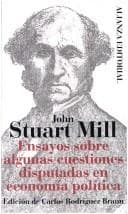
Essays on some unsettled Questions of Political EconomyMill, John Stuart
PhilosophyPhilosophy
Essays on some unsettled Questions of Political Economy
Mill, John Stuart
Economics
The end to which all labour and all expenditure are directed, is
twofold. Sometimes it is _enjoyment_ immediately; the fulfilment of
those desires, the gratification of which is wished for on its own
account. Whenever labour or expense is not incurred _immediately_ for
the sake of enjoyment, and is yet not absolutely wasted, it must be
incurred for the purpose of enjoyment _indirectly_ or mediately; by
either repairing and perpetuating, or adding, to the _permanent sources_
of enjoyment.
Sources of enjoyment may be accumulated and stored up; enjoyment itself
cannot. The wealth of a country consists of the sum total of the
permanent sources of enjoyment, whether material or immaterial, contained
in it: and labour or expenditure which tends to augment or to keep up
these permanent sources, should, we conceive, be termed productive.
Labour which is employed for the purpose of directly affording
enjoyment, such as the labour of a performer on a musical instrument, we
term unproductive labour. Whatever is consumed by such a performer, we
consider as unproductively consumed: the accumulated total of the
sources of enjoyment which the nation possesses, is diminished by the
amount of what he has consumed: whereas, if it had been given to him in
exchange for his services in producing food or clothing, the total of
the permanent sources of enjoyment in the country might have been not
diminished but increased.
The performer on the musical instrument then is, so far as respects that
act, not a productive, but an unproductive labourer. But what shall we
say of the workman who made the musical instrument? He, most persons
would say, is a productive labourer; and with reason; because the
musical instrument is a permanent source of enjoyment, which does not
begin and end with the enjoying, and therefore admits of being
accumulated.
But the _skill_ of the musician is a permanent source of enjoyment, as
well as the instrument which he plays upon: and although skill is not a
material object, but a quality of an object, viz., of the hands and mind
of the performer; nevertheless skill possesses exchangeable value, is
acquired by labour and capital, and is capable of being stored and
accumulated. Skill, therefore, must be considered as wealth; and the
labour and funds employed in acquiring skill in anything tending to the
advantage or pleasure of mankind, must be considered to be productively
employed and expended.
Public-domain text, read in full here on John Shaqi.
Reviews
Reviews
No reviews yet
Be the first to share your thoughts on this work.
Elsewhere in the archive
Join the Discussion
Join the discussion
Sign in to leave a comment or review.
Sign InorCreate an account