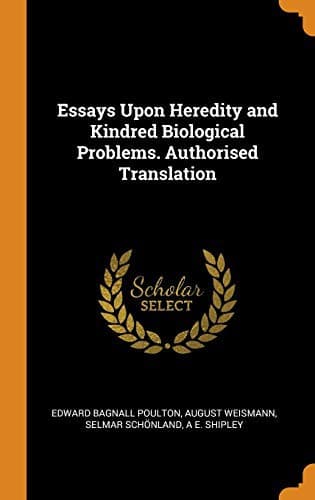
Essays Upon Heredity and Kindred Biological Problems: Authorised TranslationWeismann, August
Science
Essays Upon Heredity and Kindred Biological Problems: Authorised Translation
Weismann, August
Evolution (Biology); Genetics; Reproduction
But does it therefore follow that the quantity of germ-plasm in the
segmentation nucleus is not the factor which determines the beginning
of embryonic development? I believe not. It can be very well imagined
that the nucleus of the egg, having expelled the ovogenetic
nucleoplasm, may be increased to the size requisite for the
segmentation nucleus in one of two ways: either by conjugation with a
sperm-nucleus, or by simply growing to double its size. There is
nothing improbable in this latter assumption, and one is even inclined
to inquire why such growth does not take place in all unfertilized
eggs. The true answer to this question must be that nature generally
pursues the sexual method of reproduction, and that the only way in
which the general occurrence of parthenogenesis could be prevented, was
by the production of eggs which remained sterile unless they were
fertilized. This was effected by a loss of the capability of growth on
the part of the egg-nucleus after it had expelled the ovogenetic
nucleoplasm.
The case of the bee proves in a very striking manner that the
difference between eggs which require fertilization, and those which do
not, is not produced until after the maturation of the egg, and the
removal of the ovogenetic nucleoplasm. The increase in the quantity of
the germ-plasm cannot have taken place at any earlier period, or else
the nucleus of the egg would always start embryonic development by
itself, and the egg would probably be incapable of fertilization. For
the relation between egg-nucleus and sperm-nucleus is obviously based
upon the fact that each of them is insufficient by itself, and requires
completion. If such completion had taken place at an early stage the
egg-nucleus would either cease to exercise any attractive force upon
the sperm-nucleus, or else conjugation would be effected, as in Fol’s
interesting experiments upon fertilization by many spermatozoa; and, as
in these experiments, malformation of the embryo would result. In
_Daphnidae_ I believe I have shown[166] that the summer-eggs are not
only developed parthenogenetically, but also that they are never
fertilized; and the explanation of this incapacity for fertilization
may perhaps be found in the fact that their segmentation nucleus is
already formed.
We may therefore conclude that, in bees, the nucleus of the egg, formed
during maturation, may either conjugate with the sperm-nucleus, or else
if no spermatozoon reaches the egg may, under the stimulus of internal
causes, grow to double its size, thus attaining the dimensions of the
segmentation nucleus. For our present purpose we may leave out of
consideration the fact that in the latter case the individual produced
is a male, and in the former case a female.
Public-domain text, read in full here on John Shaqi.
Reviews
Reviews
No reviews yet
Be the first to share your thoughts on this work.
Elsewhere in the archive
Join the Discussion
Join the discussion
Sign in to leave a comment or review.
Sign InorCreate an account