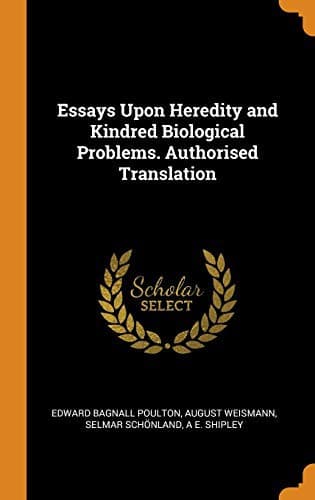
Essays Upon Heredity and Kindred Biological Problems: Authorised TranslationWeismann, August
Science
Essays Upon Heredity and Kindred Biological Problems: Authorised Translation
Weismann, August
Evolution (Biology); Genetics; Reproduction
At first sight this conclusion appears to be very startling and almost
incredible, because we are on the contrary inclined to believe that the
continued combination of existing differences, which is implied by the
very existence of amphigonic reproduction, cannot lead to their
intensification, but rather to their diminution and gradual
obliteration. Indeed the opinion has already been expressed that
deviations from the specific type are rapidly destroyed by the
operation of sexual reproduction. Such an opinion may be true with
regard to specific characters, because the deviations from a specific
type occur in such rare cases that they cannot hold their ground
against the large number of normal individuals. But the case is
different with those minute differences which are characteristic of
individuals, because every individual possesses them, although of a
different kind and degree. The extinction of such differences could
only take place if a few individuals constituted a whole species; but
the number of individuals which together represent a species is not
only very large but generally incalculable. Cross-breeding between all
individuals is impossible, and hence the obliteration of individual
differences is also impossible.
In order to explain the effects of sexual reproduction, we will first
of all consider what happens in monogonic or unisexual reproduction,
which actually occurs in parthenogenetic organisms. Let us imagine an
individual producing germ-cells, each of which may by itself develope
into a new individual. If we then suppose a species to be made up of
individuals which are absolutely identical, it follows that their
descendants must also remain identical through any number of
generations, if we neglect the transient non-transmissible
peculiarities caused by differences of food and other external
conditions.
Although the individuals of such a species might be actually different,
they would be potentially identical: in the mature state they might
differ, but they must have been identical in origin. The germs of all
of them must contain exactly the same hereditary tendencies, and if it
were possible for their development to take place under exactly the
same conditions, identical individuals would be produced.
Public-domain text, read in full here on John Shaqi.
Reviews
Reviews
No reviews yet
Be the first to share your thoughts on this work.
Elsewhere in the archive
Join the Discussion
Join the discussion
Sign in to leave a comment or review.
Sign InorCreate an account