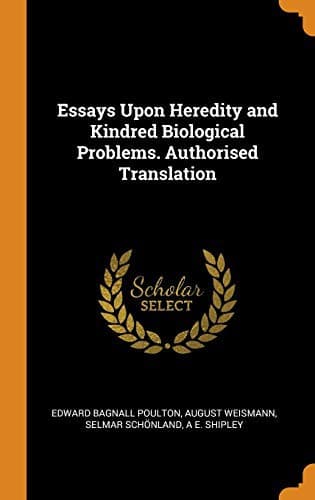
Essays Upon Heredity and Kindred Biological Problems: Authorised TranslationWeismann, August
Science
Essays Upon Heredity and Kindred Biological Problems: Authorised Translation
Weismann, August
Evolution (Biology); Genetics; Reproduction
a new generation at a later period. Here, therefore, sexual
reproduction has not been abandoned accidentally or from any internal
cause, but as an adaptation to certain definite necessities imposed
upon the organism by its surroundings.
It is, however, well known that there are certain instances in which
sexual reproduction has been altogether lost, and in which
parthenogenesis is the only form of propagation. In the animal kingdom,
such a condition chiefly occurs in species of which the closely-allied
forms exhibit the above-mentioned alternation between parthenogenesis
and amphigony, viz. in many _Cynipidae_ and _Aphidae_, and also in
certain freshwater and marine Crustacea. We may imagine that these
parthenogenetic species have arisen from forms with alternating methods
of reproduction, by the disappearance of the sexual phase.
In any particular case, it may be difficult to point out the motive by
which this change has been determined; but it is most probable that the
same conditions which originally caused the intercalation of a
parthenogenetic stage have been efficient in causing the gradual
disappearance of the sexual stage. If a species of Crustacean, with the
above-described alternating method of reproduction (heterogeny), were
killed off by its enemies on a larger scale than before, it is obvious
that the threatened extinction of the species could be checked by the
attainment of a correspondingly greater degree of fertility. Such
increased fertility might well be produced by pure parthenogenesis (see
Appendix V, p. 323), by means of which the number of egg-producing
individuals in all the previous sexual generations would be doubled.
In a certain sense, this would be the last and most extreme method by
means of which a species might secure continued existence, for it is a
method for which it would have to pay very dearly at a later period. If
my theory as to the causes of hereditary individual variability be
correct, it follows that all species with purely parthenogenetic
reproduction are sure to die out; not, indeed, because of any failure
in meeting the existing conditions of life, but because they are
incapable of transforming themselves into new species, or, in fact, of
adapting themselves to any new conditions. Such species can no longer
be subject to the process of natural selection, because, with the
disappearance of sexual reproduction, they have also lost the power of
combining and increasing those hereditary individual characters which
they possess.
Public-domain text, read in full here on John Shaqi.
Reviews
Reviews
No reviews yet
Be the first to share your thoughts on this work.
Elsewhere in the archive
Join the Discussion
Join the discussion
Sign in to leave a comment or review.
Sign InorCreate an account