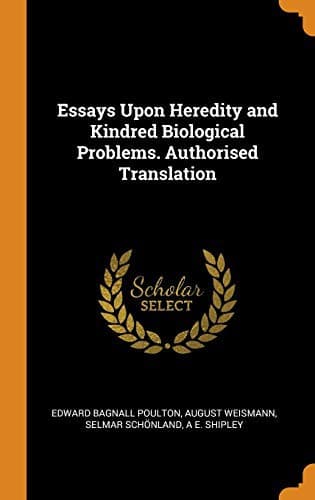
Essays Upon Heredity and Kindred Biological Problems: Authorised TranslationWeismann, August
Science
Essays Upon Heredity and Kindred Biological Problems: Authorised Translation
Weismann, August
Evolution (Biology); Genetics; Reproduction
But in this often repeated criticism that we are not yet ready to
attack such complicated phenomena as heredity, is hidden still another
fallacy, for it is implied that facts become less certain in proportion
to the complexity of their causes. But is it less certain that the egg
of an eagle developes into an eagle, or that the peculiarities of the
father and mother are transmitted to the child, than that a stone falls
to the ground when its support is taken away? Again, is it not possible
to draw a perfectly distinct and certain conclusion as to the relative
quantity of the material basis of heredity, present in the germ-cells
of either parent, from the fact that the father and mother possess an
equal or nearly equal share in heredity? But it is really unnecessary
to argue in this way: why should we do more than re-affirm that such a
method of procedure in scientific investigation is the only way by
which we can gradually penetrate the hidden depths of natural phenomena?
No! Biology is not obliged to wait until Physics and Chemistry are
completely finished; nor have we to wait for the investigation of the
phenomena of heredity until the physiology of the cell is complete.
Instead of comparing the progress of science to a building, I should
prefer to compare it to a mining operation, undertaken in order to open
up a freely branching lode. Such a lode must not be attacked from one
point alone, but from many points simultaneously. From some of these we
should quickly reach the deep-seated parts of the lode, from others we
should only reach its superficial parts; but from every point some
knowledge of the complex _tout ensemble_ of the lode would be gained.
And the more numerous the points of attack, the more complete would be
the knowledge acquired, for valuable insight will be obtained in every
place where the work is carried on with discretion and perseverance.
But discretion is indispensable for a fruitful result; or, leaving our
metaphor, facts must be connected together by theories, if science is
to advance. Just as theories are valueless without a firm basis of
facts, so the mere collection of facts, without relation and without
coherence, is utterly valueless. Science is impossible without
hypotheses and theories: they are the plummets with which we test the
depth of the ocean of unknown phenomena, and thus determine the future
course to be pursued on our voyage of discovery. They do not give us
absolute knowledge, but they afford us as much insight as it is
possible for us to gain at the present time. To go on investigating
without the guidance of theories, is like attempting to walk in a thick
mist without a track and without a compass. We should get somewhere
under these circumstances, but chance alone would determine whether we
should reach a stony desert of unintelligible facts or a system of
roads leading in some useful direction; and in most cases chance would
decide against us.
Public-domain text, read in full here on John Shaqi.
Reviews
Reviews
No reviews yet
Be the first to share your thoughts on this work.
Elsewhere in the archive
Join the Discussion
Join the discussion
Sign in to leave a comment or review.
Sign InorCreate an account