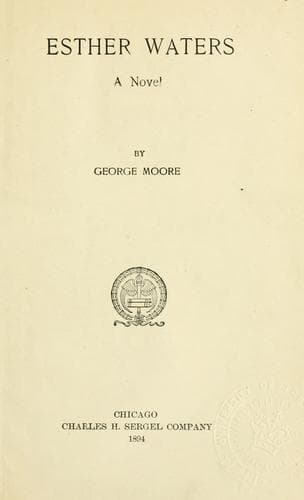
Domestic fiction; England -- Fiction; Mothers and sons -- Fiction; Unmarried mothers -- Fiction; Women household employees -- Fiction
They were in the midst of those few days of sunny weather which come in
January, deluding us so with their brightness and warmth that we look
round for roses and are astonished to see the earth bare of flowers. And
these bright afternoons Esther spent entirely with Jackie. At the top of
the hill their way led through a narrow passage between a brick wall and a
high paling. She had always to carry him through this passage, for the
ground there was sloppy and dirty, and the child wanted to stop to watch
the pigs through the chinks in the boards. But when they came to the
smooth, wide, high roads overlooking the valley, she put him down, and he
would run on ahead, crying, "Turn for a walk, Mummie, turn along," and his
little feet went so quickly beneath his frock that it seemed as if he were
on wheels. She followed, often forced to break into a run, tremulous lest
he should fall. They descended the hill into the ornamental park, and
spent happy hours amid geometrically-designed flower-beds and curving
walks. She ventured with him as far as the old Dulwich village, and they
strolled through the long street. Behind the street were low-lying,
shiftless fields, intersected with broken hedges. And when Jackie called
to his mother to carry him, she rejoiced in the labour of his weight; and
when he grew too heavy, she rested on the farm-gate, and looked into the
vague lowlands. And when the chill of night awoke her from her dream she
clasped Jackie to her bosom and turned towards home, very soon to lose
herself again in another tide of happiness.
The evenings, too, were charming. When the candles were lighted, and tea
was on the table, Esther sat with the dozing child on her knee, looking
into the flickering fire, her mind a reverie, occasionally broken by the
homely talk of her companion; and when the baby was laid in his cot she
took up her sewing--she was making herself a new dress; or else the great
kettle was steaming on the hob, and the women stood over the washing-tubs.
On the following evening they worked on either side of the ironing-table,
the candle burning brightly and their vague woman's chatter sounding
pleasant in the hush of the little cottage. A little after nine they were
in bed, and so the days went softly, like happy, trivial dreams. It was
not till the end of the third week that Mrs. Lewis would hear of Esther
looking out for another place. And then Esther was surprised at her good
fortune. A friend of Mrs. Lewis's knew a servant who was leaving her
situation in the West End of London. Esther got the address, and went next
day after the place. She was fortunate enough to obtain it, and her
mistress seemed well satisfied with her. But one day in the beginning of
her second year of service she was told that her mistress wished to speak
to her in the dining-room.
"I fancy," said the cook, "that it is about that baby of yours; they're
very strict here."
Public-domain text, read in full here on John Shaqi.
Reviews
Reviews
No reviews yet
Be the first to share your thoughts on this work.
Elsewhere in the archive
Join the Discussion
Join the discussion
Sign in to leave a comment or review.
Sign InorCreate an account