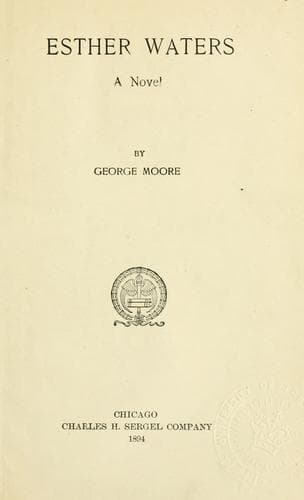
Domestic fiction; England -- Fiction; Mothers and sons -- Fiction; Unmarried mothers -- Fiction; Women household employees -- Fiction
He had been at West Kensington a fortnight, had served Esther once with
sermon paper, and had already begun to wonder what were her religious
beliefs. But bearing in mind his recent dismissal, he refrained for the
present. At the end of the week they were alone in the shop. Esther had
come for a packet of note-paper. Fred was sorry she had not come for
sermon paper; if she had it would have been easier to inquire her opinions
regarding the second coming. But the opportunity, such as it was, was not
to be resisted. He said--
"Your mistress seems to use a great deal of paper; it was only a day or
two ago that I served you with four quires."
"That was for her books; what she now wants is note-paper."
"So your mistress writes books!"
"Yes."
"I hope they're good books--books that are helpful." He paused to see that
no one was within earshot. "Books that bring sinners back to the Lord."
"I don't know what she writes; I only know she writes books; I think I've
heard she writes novels."
Fred did not approve of novels--Esther could see that--and she was sorry;
for he seemed a nice, clear-spoken young man, and she would have liked to
tell him that her mistress was the last person who would write anything
that could do harm to anyone. But her mistress was waiting for her paper,
and she took leave of him hastily. The next time they met was in the
evening. She was going to see if she could get some fresh eggs for her
mistress's breakfast before the shops closed, and coming towards her,
walking at a great pace, she saw one whom she thought she recognised, a
meagre little man with long reddish hair curling under the brim of a large
soft black hat. He nodded, smiling pleasantly as he passed her.
"Lor'," she thought, "I didn't know him; it's the stationer's foreman."
And the very next evening they met in the same street; she was out for a
little walk, he was hurrying to catch his train. They stopped to pass the
time of day, and three days after they met at the same time, and as nearly
as possible at the same place.
"We're always meeting," he said.
"Yes, isn't it strange?... You come this way from business?" she said.
"Yes; about eight o'clock is my time."
It was the end of August; the stars caught fire slowly in the murky London
sunset; and, vaguely conscious of a feeling of surprise at the pleasure
they took in each other's company, they wandered round a little bleak
square in which a few shrubs had just been planted. They took up the
conversation exactly at the point where it had been broken off.
"I'm sorry," Fred said, "that the paper isn't going to be put to better
use."
"You don't know my mistress, or you wouldn't say that."
"Perhaps you don't know that novels are very often stories about the loves
of men for other men's wives. Such books can serve no good purpose."
"I'm sure my mistress don't write about such things. How could she, poor
dear innocent lamb? It is easy to see you don't know her."
Public-domain text, read in full here on John Shaqi.
Reviews
Reviews
No reviews yet
Be the first to share your thoughts on this work.
Elsewhere in the archive
Join the Discussion
Join the discussion
Sign in to leave a comment or review.
Sign InorCreate an account