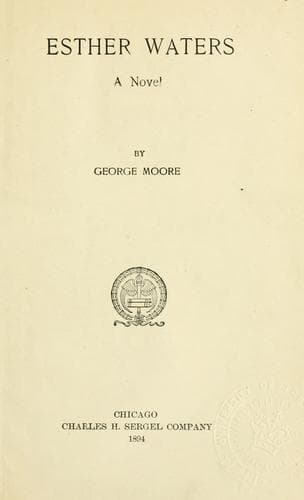
Domestic fiction; England -- Fiction; Mothers and sons -- Fiction; Unmarried mothers -- Fiction; Women household employees -- Fiction
Woodview had been all her unhappiness and all her misfortune. She had gone
there when the sap of life was flowing fastest in her, and Woodview had
become the most precise and distinct vision she had gathered from life.
She remembered that wholesome and ample country house, with its park and
its down lands, and the valley farm, sheltered by the long lines of elms.
She remembered the race-horses, their slight forms showing under the grey
clothing, the round black eyes looking out through the eyelet holes in the
hanging hoods, the odd little boys astride--a string of six or seven
passing always before the kitchen windows, going through the paddock gate
under the bunched evergreens. She remembered the rejoicings when the horse
won at Goodwood, and the ball at the Shoreham Gardens. Woodview had meant
too much in her life to be forgotten; its hillside and its people were
drawn out in sharp outline on her mind. Something in William's voice
recalled her from her reverie, and she heard him say--
"The poor Gaffer, 'e never got over it; it regular broke 'im up. I forgot
to tell you, it was Ginger who was riding. It appears that he did all he
knew; he lost start, he tried to get shut in, but it warn't no go, luck
was against them; the 'orse was full of running, and, of course, he
couldn't sit down and saw his blooming 'ead off, right in th' middle of
the course, with Sir Thomas's (that's the 'andicapper) field-glasses on
him. He'd have been warned off the blooming 'eath, and he couldn't afford
that, even to save his own father. The 'orse won in a canter: they clapped
eight stun on him for the Cambridgeshire. It broke the Gaffer's 'eart. He
had to sell off his 'orses, and he died soon after the sale. He died of
consumption. It generally takes them off earlier; but they say it is in
the family. Miss May----"
"Oh, tell me about her," said Esther, who had been thinking all the while
of Mrs. Barfield and of Miss Mary. "Tell me, there's nothing the matter
with Miss Mary?"
"Yes, there is: she can't live no more in England; she has to go to
winter, I think it is, in Algeria."
At that moment the train screeched along the rails, and vibrating under
the force of the brakes, it passed out of the tunnel into Blackfriars.
"We shall just be able to catch the ten minutes past four to Peckham," she
said, and they ran up the high steps. William strode along so fast that
Esther was obliged to cry out, "There's no use, William; train or no
train, I can't walk at that rate."
There was just time for them to get their tickets at Ludgate Hill. They
were in a carriage by themselves, and he proposed to draw up the windows
so that they might be able to talk more easily. He was interested in the
ill-luck that had attended certain horses, and Esther wanted to hear about
Mrs. Barfield.
"You seem to be very fond of her; what did she do for you?"
"Everything--that was after you went away. She was kind."
"I'm glad to hear that," said William.
Public-domain text, read in full here on John Shaqi.
Reviews
Reviews
No reviews yet
Be the first to share your thoughts on this work.
Elsewhere in the archive
Join the Discussion
Join the discussion
Sign in to leave a comment or review.
Sign InorCreate an account