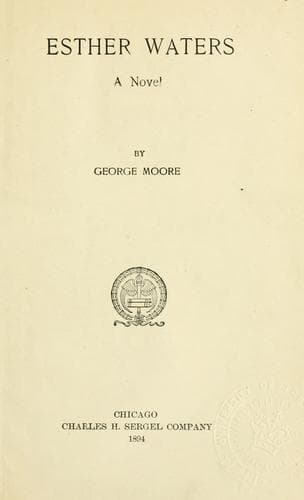
Domestic fiction; England -- Fiction; Mothers and sons -- Fiction; Unmarried mothers -- Fiction; Women household employees -- Fiction
He might linger on a long while--there
was no knowing, but he would never be able to do any work, that was
certain (unless he went out to Egypt); the doctor had said so, and then it
would be she who would have to support him. And if God were merciful
enough to take him off at once he would leave her in a worse plight than
he had found her in, and the boy growing up! Oh, it was terrible! He
buried his face in his hands, and seemed quite overcome. Then the cough
would take him, and for a few minutes he could only think of himself.
Esther gave him a little milk to drink, and he said--
"There's a hundred pounds left, Esther. It isn't much, but it's something.
I don't believe that there's much use in my going to Egypt. I shall never
get well. It is better that I should pitch myself into the river. That
would be the least selfish way out of it."
"William, I will not have you talk in that way," Esther said, laying down
her work and going over to him. "If you was to do such a thing I should
never forgive you. I could never think the same of you."
"All right, old girl, don't be frightened. I've been thinking too much
about them horses, and am a bit depressed. I daresay it will come out all
right. I think that Mahomet is sure to win the Great Ebor, don't you?"
"I don't think there's no better judge than yourself. They all say if he
don't fall lame that he's bound to win."
"Then Mahomet shall carry my money. I'll back him to-morrow."
Now that he had made up his mind what horse to back his spirits revived.
He was able to dismiss the subject from his mind, and they talked of other
things, of their son, and they laid projects for his welfare. But on the
day of the race, from early morning, William could barely contain himself.
Usually he took his winnings and losings very quietly. When he had been
especially unlucky he swore a bit, but Esther had never seen any great
excitement before a race was run. The issues of this race were
extraordinary, and it was heart-breaking to see him suffer; he could not
remain still a moment. A prey to all the terrors of hope, exhausted with
anticipation, he rested himself against the sideboard and wiped drops of
sweat from his forehead. A broiling sunlight infested their window-panes,
the room grew oven-like, and he was obliged at last to go into the back
parlour and lie down. He lay there in his shirt sleeves quite exhausted,
hardly able to breathe; the arm once so strong and healthy was shrunken to
a little nothing. He seemed quite bloodless, and looking at him Esther
could hardly hope that any climate would restore him to health. He just
asked her what the time was, and said, "The race is being run now." A few
minutes after he said, "I think Mahomet has won. I fancied I saw him get
first past the post." He spoke as if he were sure, and said nothing about
the evening paper. If he were disappointed, Esther felt that it would kill
him, and she knelt down by the bedside and prayed that God would allow the
horse to win.
Public-domain text, read in full here on John Shaqi.
Reviews
Reviews
No reviews yet
Be the first to share your thoughts on this work.
Elsewhere in the archive
Join the Discussion
Join the discussion
Sign in to leave a comment or review.
Sign InorCreate an account