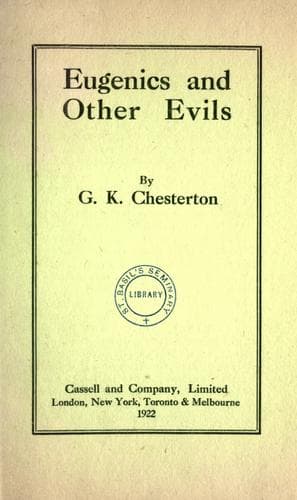
Eugenics and Other EvilsChesterton, G. K. (Gilbert Keith)
Philosophy
Eugenics and Other Evils
Chesterton, G. K. (Gilbert Keith)
Eugenics
The only place where it is possible to find an echo of the mind of the
English masses is either in conversation or in comic songs. The latter
are obviously the more dubious; but they are the only things recorded
and quotable that come anywhere near it. We talk about the popular
Press; but in truth there is no popular Press. It may be a good thing;
but, anyhow, most readers would be mildly surprised if a newspaper
leading article were written in the language of a navvy. Sometimes the
Press is interested in things in which the democracy is also genuinely
interested; such as horse-racing. Sometimes the Press is about as
popular as the Press Gang. We talk of Labour leaders in Parliament;
but they would be highly unparliamentary if they talked like
labourers. The Bolshevists, I believe, profess to promote something
that they call "proletarian art," which only shows that the word
Bolshevism can sometimes be abbreviated into bosh. That sort of
Bolshevist is not a proletarian, but rather the very thing he accuses
everybody else of being. The Bolshevist is above all a bourgeois; a
Jewish intellectual of the town. And the real case against industrial
intellectualism could hardly be put better than in this very
comparison. There has never been such a thing as proletarian art; but
there has emphatically been such a thing as peasant art. And the only
literature which even reminds us of the real tone and talk of the
English working classes is to be found in the comic song of the
English music-hall.
I first heard one of them on my voyage to America, in the midst of the
sea within sight of the New World, with the Statue of Liberty
beginning to loom up on the horizon. From the lips of a young Scotch
engineer, of all people in the world, I heard for the first time these
immortal words from a London music-hall song:--
"Father's got the sack from the water-works
For smoking of his old cherry-briar;
Father's got the sack from the water-works
'Cos he might set the water-works on fire."
As I told my friends in America, I think it no part of a patriot to
boast; and boasting itself is certainly not a thing to boast of. I
doubt the persuasive power of English as exemplified in Kipling, and
one can easily force it on foreigners too much, even as exemplified in
Dickens. I am no Imperialist, and only on rare and proper occasions a
Jingo. But when I hear those words about Father and the water-works,
when I hear under far-off foreign skies anything so gloriously English
as that, then indeed (I said to them), then indeed:--
"I thank the goodness and the grace
That on my birth have smiled,
And made me, as you see me here,
A little English child."
Public-domain text, read in full here on John Shaqi.
Reviews
Reviews
No reviews yet
Be the first to share your thoughts on this work.
Elsewhere in the archive
Join the Discussion
Join the discussion
Sign in to leave a comment or review.
Sign InorCreate an account