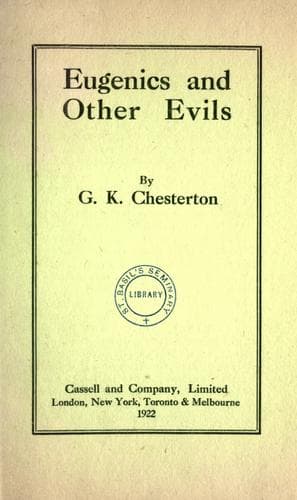
Eugenics and Other EvilsChesterton, G. K. (Gilbert Keith)
Philosophy
Eugenics and Other Evils
Chesterton, G. K. (Gilbert Keith)
Eugenics
This would in itself have been a sufficiently irritating interruption
in the early life of Eugenette, and in the early establishment of
Eugenics. But a far more dreadful and disconcerting fact must be
noted. With whom, alas, did England go to war? England went to war
with the Superman in his native home. She went to war with that very
land of scientific culture from which the very ideal of a Superman had
come. She went to war with the whole of Dr. Steinmetz, and presumably
with at least half of Dr. Karl Pearson. She gave battle to the
birthplace of nine-tenths of the professors who were the prophets of
the new hope of humanity. In a few weeks the very name of a professor
was a matter for hissing and low plebeian mirth. The very name of
Nietzsche, who had held up this hope of something superhuman to
humanity, was laughed at for all the world as if he had been touched
with lunacy. A new mood came upon the whole people; a mood of
marching, of spontaneous soldierly vigilance and democratic
discipline, moving to the faint tune of bugles far away. Men began to
talk strangely of old and common things, of the counties of England,
of its quiet landscapes, of motherhood and the half-buried religion of
the race. Death shone on the land like a new daylight, making all
things vivid and visibly dear. And in the presence of this awful
actuality it seemed, somehow or other, as if even Mr. Bolce and the
Eugenic baby were things unaccountably far-away and almost, if one may
say so, funny.
Such a revulsion requires explanation, and it may be briefly given.
There was a province of Europe which had carried nearer to perfection
than any other the type of order and foresight that are the subject
of this book. It had long been the model State of all those more
rational moralists who saw in science the ordered salvation of
society. It was admittedly ahead of all other States in social reform.
All the systematic social reforms were professedly and proudly
borrowed from it. Therefore when this province of Prussia found it
convenient to extend its imperial system to the neighbouring and
neutral State of Belgium, all these scientific enthusiasts had a
privilege not always granted to mere theorists. They had the
gratification of seeing their great Utopia at work, on a grand scale
and very close at hand. They had not to wait, like other evolutionary
idealists, for the slow approach of something nearer to their dreams;
or to leave it merely as a promise to posterity. They had not to wait
for it as for a distant thing like the vision of a future state; but
in the flesh they had seen their Paradise. And they were very silent
for five years.
Public-domain text, read in full here on John Shaqi.
Reviews
Reviews
No reviews yet
Be the first to share your thoughts on this work.
Elsewhere in the archive
Join the Discussion
Join the discussion
Sign in to leave a comment or review.
Sign InorCreate an account