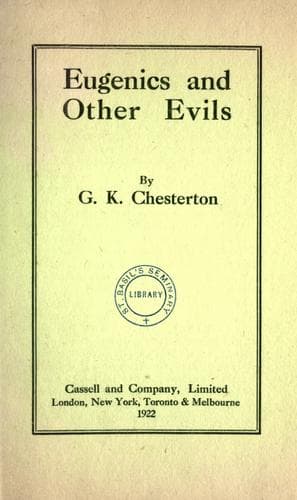
Eugenics and Other EvilsChesterton, G. K. (Gilbert Keith)
Philosophy
Eugenics and Other Evils
Chesterton, G. K. (Gilbert Keith)
Eugenics
Now, if any ask whether it be imaginable that an ordinary man of the
wealthier type should analyse the problem or conceive the plan, the
inhumanly far-seeing plan, as I have set it forth, the answer is:
"Certainly not." Many rich employers are too generous to do such a
thing; many are too stupid to know what they are doing. The eugenical
opportunity I have described is but an ultimate analysis of a whole
drift of thoughts in the type of man who does not analyse his
thoughts. He sees a slouching tramp, with a sick wife and a string of
rickety children, and honestly wonders what he can do with them. But
prosperity does not favour self-examination; and he does not even ask
himself whether he means "How can I help them?" or "How can I use
them?"--what he can still do for them, or what they could still do for
him. Probably he sincerely means both, but the latter much more than
the former; he laments the breaking of the tools of Mammon much more
than the breaking of the images of God. It would be almost impossible
to grope in the limbo of what he does think; but we can assert that
there is one thing he doesn't think. He doesn't think, "This man might
be as jolly as I am, if he need not come to me for work or wages."
That this is so, that at root the Eugenist is the Employer, there are
multitudinous proofs on every side, but they are of necessity
miscellaneous, and in many cases negative. The most enormous is in a
sense the most negative: that no one seems able to imagine capitalist
industrialism being sacrificed to any other object. By a curious
recurrent slip in the mind, as irritating as a catch in a clock,
people miss the main thing and concentrate on the mean thing. "Modern
conditions" are treated as fixed, though the very word "modern"
implies that they are fugitive. "Old ideas" are treated as impossible,
though their very antiquity often proves their permanence. Some years
ago some ladies petitioned that the platforms of our big railway
stations should be raised, as it was more convenient for the hobble
skirt. It never occurred to them to change to a sensible skirt. Still
less did it occur to them that, compared with all the female fashions
that have fluttered about on it, by this time St. Pancras is as
historic as St. Peter's.
Public-domain text, read in full here on John Shaqi.
Reviews
Reviews
No reviews yet
Be the first to share your thoughts on this work.
Elsewhere in the archive
Join the Discussion
Join the discussion
Sign in to leave a comment or review.
Sign InorCreate an account