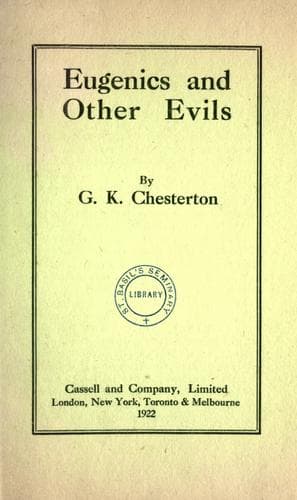
Eugenics and Other EvilsChesterton, G. K. (Gilbert Keith)
Philosophy
Eugenics and Other Evils
Chesterton, G. K. (Gilbert Keith)
Eugenics
The important point is, however, that there is more fact and realism
in the wildest and most elegant old fictions about disinherited dukes
and long-lost daughters than there is in this Eugenist attempt to make
the poor all of a piece--a sort of black fungoid growth that is
ceaselessly increasing in a chasm. There is a cheap sneer at poor
landladies: that they always say they have seen better days. Nine
times out of ten they say it because it is true. What can be said of
the great mass of Englishmen, by anyone who knows any history, except
that they have seen better days? And the landlady's claim is not
snobbish, but rather spirited; it is her testimony to the truth in the
old tales of which I spoke: that she _ought not_ to be so poor or so
servile in status; that a normal person ought to have more property
and more power in the State than _that_. Such dreams of lost dignity
are perhaps the only things that stand between us and the
cattle-breeding paradise now promised. Nor are such dreams by any
means impotent. I remember Mr. T.P. O'Connor wrote an interesting
article about Madame Humbert, in the course of which he said that
Irish peasants, and probably most peasants, tended to have a
half-fictitious family legend about an estate to which they were
entitled. This was written in the time when Irish peasants were
landless in their land; and the delusion doubtless seemed all the more
entertaining to the landlords who ruled them and the money-lenders who
ruled the landlords. But the dream has conquered the realities. The
phantom farms have materialised. Merely by tenaciously affirming the
kind of pride that comes after a fall, by remembering the old
civilisation and refusing the new, by recurring to an old claim that
seemed to most Englishmen like the lie of a broken-down lodging-house
keeper at Margate--by all this the Irish have got what they want, in
solid mud and turf. That imaginary estate has conquered the Three
Estates of the Realm.
But the homeless Englishman must not even remember a home. So far from
his house being his castle, he must not have even a castle in the air.
He must have no memories; that is why he is taught no history. Why is
he told none of the truth about the mediæval civilisation except a few
cruelties and mistakes in chemistry? Why does a mediæval burgher never
appear till he can appear in a shirt and a halter? Why does a mediæval
monastery never appear till it is "corrupt" enough to shock the
innocence of Henry VIII.? Why do we hear of one charter--that of the
barons--and not a word of the charters of the carpenters, smiths,
shipwrights and all the rest? The reason is that the English peasant
is not only not allowed to have an estate, he is not even allowed to
have lost one. The past has to be painted pitch black, that it may be
worse than the present.
Public-domain text, read in full here on John Shaqi.
Reviews
Reviews
No reviews yet
Be the first to share your thoughts on this work.
Elsewhere in the archive
Join the Discussion
Join the discussion
Sign in to leave a comment or review.
Sign InorCreate an account