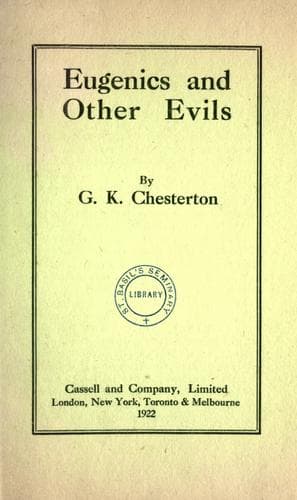
Eugenics and Other EvilsChesterton, G. K. (Gilbert Keith)
Philosophy
Eugenics and Other Evils
Chesterton, G. K. (Gilbert Keith)
Eugenics
This distinction is very important, as can be seen from any practical
parallel. Suppose we wake up in the middle of the night and find that
a neighbour has entered the house not by the front-door but by the
skylight; we may suspect that he has come after the fine old family
jewellery. We may be reassured if he can refer it to a really
exceptional event; as that he fell on to the roof out of an aeroplane,
or climbed on to the roof to escape from a mad dog. Short of the
incredible, the stranger the story the better the excuse; for an
extraordinary event requires an extraordinary excuse. But we shall
hardly be reassured if he merely gazes at us in a dreamy and wistful
fashion and says, "After all, what is property? Why should material
objects be thus artificially attached, etc., etc.?" We shall merely
realise that his attitude allows of his taking the jewellery and
everything else. Or if the neighbour approaches us carrying a large
knife dripping with blood, we may be convinced by his story that he
killed another neighbour in self-defence, that the quiet gentleman
next door was really a homicidal maniac. We shall know that homicidal
mania is exceptional and that we ourselves are so happy as not to
suffer from it; and being free from the disease may be free from the
danger. But it will not soothe us for the man with the gory knife to
say softly and pensively "After all, what is human life? Why should we
cling to it? Brief at the best, sad at the brightest, it is itself but
a disease from which, etc., etc." We shall perceive that the sceptic
is in a mood not only to murder us but to massacre everybody in the
street. Exactly the same effect which would be produced by the
questions of "What is property?" and "What is life?" is produced by
the question of "What is liberty?" It leaves the questioner free to
disregard any liberty, or in other words to take any liberties. The
very thing he says is an anticipatory excuse for anything he may
choose to do. If he gags a man to prevent him from indulging in
profane swearing, or locks him in the coal cellar to guard against his
going on the spree, he can still be satisfied with saying, "After all,
what is liberty? Man is a member of, etc., etc."
That is the problem, and that is why there is now no protection
against Eugenic or any other experiments. If the men who took away
beer as an unlawful pleasure had paused for a moment to define the
lawful pleasures, there might be a different situation. If the men who
had denied one liberty had taken the opportunity to affirm other
liberties, there might be some defence for them. But it never occurs
to them to admit any liberties at all. It never so much as crosses
their minds. Hence the excuse for the last oppression will always
serve as well for the next oppression; and to that tyranny there can
be no end.
Public-domain text, read in full here on John Shaqi.
Reviews
Reviews
No reviews yet
Be the first to share your thoughts on this work.
Elsewhere in the archive
Join the Discussion
Join the discussion
Sign in to leave a comment or review.
Sign InorCreate an account