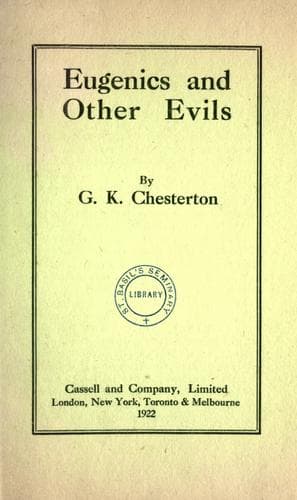
Eugenics and Other EvilsChesterton, G. K. (Gilbert Keith)
Philosophy
Eugenics and Other Evils
Chesterton, G. K. (Gilbert Keith)
Eugenics
It is better to be in a bad prison than in a good one. From the
standpoint of the prisoner this is not at all a paradox; if only
because in a bad prison he is more likely to escape. But apart from
that, a man was in many ways better off in the old dirty and corrupt
prison, where he could bribe turnkeys to bring him drink and meet
fellow-prisoners to drink with. Now that is exactly the difference
between the present system and the proposed system. Nobody worth
talking about respects the present system. Capitalism is a corrupt
prison. That is the best that can be said for Capitalism. But it is
something to be said for it; for a man is a little freer in that
corrupt prison than he would be in a complete prison. As a man can
find one jailer more lax than another, so he could find one employer
more kind than another; he has at least a choice of tyrants. In the
other case he finds the same tyrant at every turn. Mr. Shaw and other
rational Socialists have agreed that the State would be in practice
government by a small group. Any independent man who disliked that
group would find his foe waiting for him at the end of every road.
It may be said of Socialism, therefore, very briefly, that its friends
recommended it as increasing equality, while its foes resisted it as
decreasing liberty. On the one hand it was said that the State could
provide homes and meals for all; on the other it was answered that
this could only be done by State officials who would inspect houses
and regulate meals. The compromise eventually made was one of the most
interesting and even curious cases in history. It was decided to do
everything that had ever been denounced in Socialism, and nothing that
had ever been desired in it. Since it was supposed to gain equality at
the sacrifice of liberty, we proceeded to prove that it was possible
to sacrifice liberty without gaining equality. Indeed, there was not
the faintest attempt to gain equality, least of all economic equality.
But there was a very spirited and vigorous effort to eliminate
liberty, by means of an entirely new crop of crude regulations and
interferences. But it was not the Socialist State regulating those
whom it fed, like children or even like convicts. It was the
Capitalist State raiding those whom it had trampled and deserted in
every sort of den, like outlaws or broken men. It occurred to the
wiser sociologists that, after all, it would be easy to proceed more
promptly to the main business of bullying men, without having gone
through the laborious preliminary business of supporting them. After
all, it was easy to inspect the house without having helped to build
it; it was even possible, with luck, to inspect the house in time to
prevent it being built. All that is described in the documents of the
Housing Problem; for the people of this age loved problems and hated
solutions. It was easy to restrict the diet without providing the
dinner. All that can be found in the documents of what is called
Public-domain text, read in full here on John Shaqi.
Reviews
Reviews
No reviews yet
Be the first to share your thoughts on this work.
Elsewhere in the archive
Join the Discussion
Join the discussion
Sign in to leave a comment or review.
Sign InorCreate an account