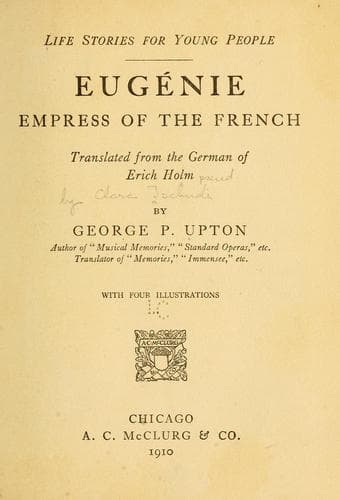
Eugénie, Empress, consort of Napoleon III, Emperor of the French, 1826-1920; Napoleon III, Emperor of the French, 1808-1873 -- Marriage
Early on the morning of Sunday, the seventh of August, the Empress came
to Paris and immediately sent for the ministers and the presidents of
the Legislative Assembly and the Senate. The next day Paris was declared
in a state of siege and a proclamation issued by the Empress, urging the
citizens to maintain order and rally to the support of France that her
losses might be retrieved. She already imagined herself at the head of
affairs, taking active measures for the defence of the capital, cheering
on the troops, and firing them with courage, a role that particularly
appealed to her fancy; but the appeal made little impression. The
people, only too familiar with her fondness for theatrical effect and
admiration, clamored for action. Declamation was little to the purpose.
They wanted victories, not comedies!
Public irritation vented itself first of all against the ministry, which
was forced to resign. Émile Ollivier was succeeded by the aged General
Montauban, Count of Palikao, who had distinguished himself in the war
against China; while Trochu was appointed Governor of Paris. Further to
satisfy popular sentiment, Napoleon was forced to resign his position as
Generalissimo in favor of Marshal Bazaine, who accordingly assumed the
chief command of the army.
Under normal conditions the Emperor’s place would now have been in
Paris; but the new ministry, as well as the Empress herself, protested
against his return. Disheartened by the long delays, sore with
disappointed hopes, and furious at the supposed mistakes of the
generals, the people of Paris were ripe for revolution, and only a spark
was needed to set them aflame. The imperial pair were overwhelmed with
scorn and abuse. Already their throne was tottering, and with the
victorious advance of the Germans, conviction of its speedy downfall
grew daily stronger.
Never before had the Empress found herself in so critical a situation.
The new ministry lacked the confidence of the public and could be of no
help to her. She had no tried general to depend upon, and every trace of
the troops’ devotion to the house of Napoleon had long since vanished.
She stood alone and defenceless against an enraged populace only
awaiting a pretext to hurl itself upon her. With this daily-increasing
excitement, the brawls and dissensions caused by the army’s defeats on
the frontier, and universal anxiety for the fate of the country, Eugénie
began to understand how grievously she had erred in urging on this
“little war,” as she had referred to it in the beginning of the
campaign. Fears as to the fate of her own husband and child made her
realize for the first time the suffering of thousands of other wives and
mothers. She felt the necessity of uniting with them in some active
work, and was tireless in her efforts to atone in some measure for the
wrong she had thoughtlessly committed.
Public-domain text, read in full here on John Shaqi.
Reviews
Reviews
No reviews yet
Be the first to share your thoughts on this work.
Join the Discussion
Join the discussion
Sign in to leave a comment or review.
Sign InorCreate an account