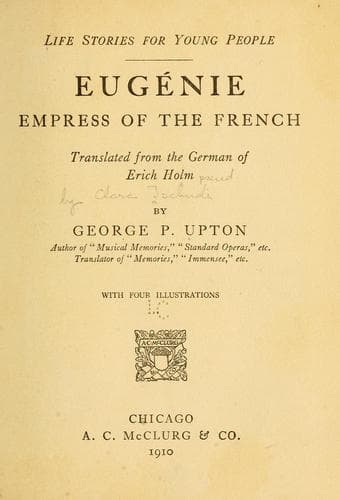
Eugénie, Empress, consort of Napoleon III, Emperor of the French, 1826-1920; Napoleon III, Emperor of the French, 1808-1873 -- Marriage
In the days of prosperity her worst qualities had been uppermost; she
had not shown the better side of her nature. It remained for misfortune
to reveal her real strength and nobility of character. In spite of the
feeling against her, she went about everywhere, personally
superintending the care of the wounded. The brilliant salons of the
Tuileries were turned into hospital wards. A new spirit seemed to
animate her and to lend her fresh strength in this time of danger. At
night she rarely slept, and even when taking a brief rest during the
day, her attendants had orders to awaken her the moment any message or
despatch arrived. No matter how worn out or exhausted she might be, she
would force herself to rise and hasten back to the bedside of the
wounded where there was so much suffering to relieve, though she had no
time to think of her own misery. Yet often in her own chamber, haunted
by the agonized cries of the dying, she would pace up and down wringing
her hands as if in bodily pain, tortured by anguish of soul. In these
hours she prayed long and fervently for her dear ones and for her
people, the women who suffered like herself, the brave men who were
fighting for their country. A feverish activity possessed her. She tried
to persuade Austria to assist France. She wrote to the Queen of England
imploring her to intervene for the sake of peace. She pardoned over two
thousand criminals. She superintended the preparations for the defence
of Paris and held innumerable consultations with Trochu, in whom she
placed the blindest and most implicit confidence. At the same time,
however, she took the precaution of having all her important private and
family papers conveyed on board the French squadron, as well as some of
the principal works of art from the Louvre. She also had a list of the
crown jewels made, to secure her against suspicion in case of extremity.
Her own personal ornaments were sent to her mother in Spain. The strain
and over-exertion of these weeks seriously affected her health and
wrought a startling change in her appearance. Tortured with suspense,
she waited from day to day for news from the seat of war; yet all that
came brought so little comfort that her advisers thought best to conceal
it from the people as far as possible.
At length came the final blow. On the afternoon of the third of
September, as the Minister of Foreign Affairs was on his way to the
Tuileries, he was met by the Superintendent of Telegraphs.
“I have just received a most important telegram for the Empress from the
Emperor,” he said. “I usually attend myself to the messages that pass
between Their Majesties, but this one I have not the courage to
deliver.” It was the well-known despatch:
“The army is defeated and has surrendered. I myself am a prisoner.
“Napoleon.”
Public-domain text, read in full here on John Shaqi.
Reviews
Reviews
No reviews yet
Be the first to share your thoughts on this work.
Join the Discussion
Join the discussion
Sign in to leave a comment or review.
Sign InorCreate an account