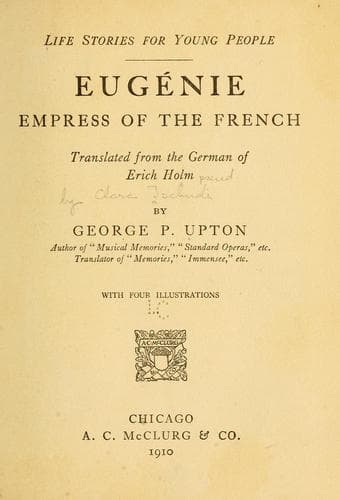
Eugénie, Empress, consort of Napoleon III, Emperor of the French, 1826-1920; Napoleon III, Emperor of the French, 1808-1873 -- Marriage
“What you mean to offer me, gentlemen, is the pledge of a peaceful
future, on condition that I renounce the present and abandon in time of
danger the post entrusted to me. That I cannot do. To such terms I
certainly will not subscribe. Go back to the Assembly and say to General
Palikao and his colleagues that I rely upon them implicitly; that I
grant them full power to take any steps proper for the interest of the
country, and approve the same in advance.”
Meanwhile the public tumult increased in violence. The red flag was
hoisted everywhere. A boy of nine years even climbed up and fastened one
to the top of the bronze railing that surrounded the Tuileries.
Thousands filled the Place de la Concorde, roaring the Marseillaise at
the top of their voices. The Assembly had again met, but so many forced
their way into the chamber, and the uproar was so great, that it was
impossible to transact any business.
“Not here shall the Republic be proclaimed,” shouted Gambetta, “but at
the Hôtel de Ville!”
This suggestion met with great applause, and the deputies adjourned to
that edifice, where a Government of National Defence was formed. The
news that the Empire no longer existed quickly spread and was hailed
with wildest enthusiasm. Not a voice was raised in behalf of the fallen
dynasty. Vast throngs invaded the Hôtel de Ville and valuable portraits
of the Emperor and Empress were hacked with knives, trampled under foot,
and tossed out of the windows. The imperial emblems were torn to pieces,
and the eagle, which could not be easily removed, was covered with
paper.
“At the windows of the huge barracks filled with troops supposed to be
loyal unto death to the Emperor,” says an eye-witness, “I saw soldiers
laughing, waving their handkerchiefs, and shouting ‘Long live the
Republic!’ Strangers hugged and kissed one another for joy. In the
neighborhood of the Pont Neuf, people mounted on high ladders were busy
pulling down busts of the Emperor, which were carried in mock state and
flung into the Seine, shouts of laughter and applause greeting the
splash with which the mutilated images of their former sovereign struck
the water.”
Chapter XII
Eugénie’s Flight to England
The Empress mean while was still at the Tuileries. One of the palace
prefects had returned from the Assembly with news of what had passed,
but she refused to desert her post even though the mob was already at
the gates of the palace and a dull roar penetrated the deserted halls.
Eugénie’s question as to whether it would be possible to defend the
Tuileries without bloodshed was answered in the negative by the governor
of the palace, General Mellinet, and she still refused to have a drop of
blood shed in her behalf. Nearer and nearer sounded the uproar, and the
trampling of feet was now distinctly audible. Shouts were heard: “She
will escape!” “Long live the Republic!” “Down with the Spaniard!”
“Forward! Into the palace—forward!”
Public-domain text, read in full here on John Shaqi.
Reviews
Reviews
No reviews yet
Be the first to share your thoughts on this work.
Join the Discussion
Join the discussion
Sign in to leave a comment or review.
Sign InorCreate an account