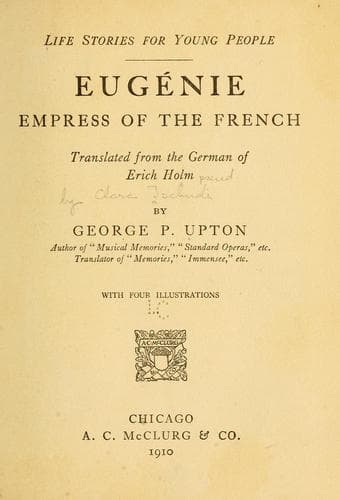
Eugénie, Empress, consort of Napoleon III, Emperor of the French, 1826-1920; Napoleon III, Emperor of the French, 1808-1873 -- Marriage
The Minister went at once to Eugénie with this terrible news, the
reality of which exceeded all that her darkest fears had painted, and
her feelings at this moment may be better imagined than described. Yet
even then she did not consider her own fate. Her only thought was for
France; and she firmly refused to employ the troops in her own defence
against the people, for that would have added the terrors of civil
strife to those of war. Late that evening the bad news reached the city,
but instead of uniting to make a brave stand against the enemy, the
populace rose in arms, and it was plain that the Empire’s days were
numbered. The streets were filled with surging throngs, shouting “Down
with the Emperor! Down with the Empress! Long live the Republic!” On all
sides was heard the expression, “An Emperor dies, but does not
surrender.”
About one o’clock that night the Legislature held a special session. Not
a member was absent, and the galleries were crowded. Amid a deathly
silence the president arose. He said:
“A calamity has brought us together here at this unwonted hour. I have
called the session to discuss our present situation.”
Not a sound broke the stillness. All eyes were fixed on the Ministers’
bench. Count Palikao rose. The aged hero was no orator, but his voice
was firm as he announced the disaster of Sedan. He added, slowly:
“With such news it is impossible for the ministry to enter into any
discussion before to-morrow. I was called from my bed only a short time
since, to come here.”
The president of the Exchequer then put the question as to whether the
meeting should be adjourned. “Aye-aye,” shouted several voices. Suddenly
a bushy head arose, and a loud, discordant voice made three
motions:—“Deposition of the Emperor; Appointment of a provisional
Government; Retention of Trochu as Governor of Paris.” It was Jules
Favre.
Only members of the Extreme Left subscribed to these motions, which were
received with surprising indifference. One member of the Right protested
against the Emperor’s deposition, but an ominous silence greeted his
words. For the rest of the night a similar silence reigned throughout
the city. It was the hush before the storm.
That Eugénie was far from suspecting an uprising is shown by the fact
that she made absolutely no preparations for flight. The next morning
she arose early, heard mass in her private chapel, and made her rounds
of the hospitals as usual. At nine o’clock she received General Trochu,
who, although only a few hours since placed at the head of the new
Government, still solemnly protested his loyalty to her. Later in the
forenoon a deputation waited on the Regent to inform her of the
appointment of a commission to assume control of the Government in her
place, in other words, to request her resignation. She listened quietly
to their explanation and dismissed them with the following words:
Public-domain text, read in full here on John Shaqi.
Reviews
Reviews
No reviews yet
Be the first to share your thoughts on this work.
Join the Discussion
Join the discussion
Sign in to leave a comment or review.
Sign InorCreate an account