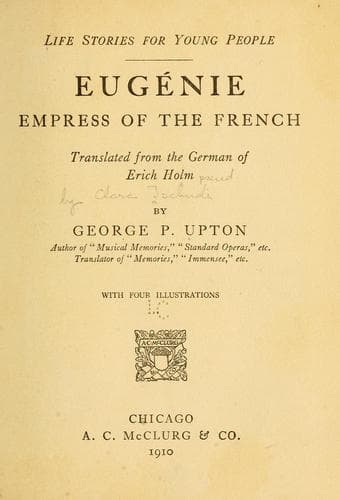
Eugénie, Empress, consort of Napoleon III, Emperor of the French, 1826-1920; Napoleon III, Emperor of the French, 1808-1873 -- Marriage
There could have been no greater contrast than that of the life that now
began for Eugénie in Hastings, with her brilliant career as Empress, or
even with that troubled war-time and the dangers and excitements through
which she had passed. Torn by alternations of hope, fear, and
disappointment, she had scarcely had time during the past month to think
of herself, much less give way to her feelings. Here, at the Marine
Hotel, for the first time she found leisure to look back on what had
happened and to review her past life—that inevitable time of reckoning
from which no life is wholly free. Hitherto she had known nothing but
gratified desires, glittering triumphs, and realized ambitions. She had
had no cause to distrust friends or doubt their loyalty, no experience
of ingratitude. Rarely forgetful of a service done her, and incapable of
falsehood herself, she had preserved an almost childlike faith in human
nature. Now, for the first time, fate was to make her thoroughly
familiar with this bitterest chapter in the book of experience. Scarcely
had she turned her back on the Tuileries before her own servants rifled
her apartments. Later, when news came that the rabble had broken into
the palace and wrought havoc there, Eugénie’s first thought was “Poor
Trochu!”
“Why do you pity him?” asked her companion, in surprise.
“Because he has sworn so often to me that only over his dead body should
any assailant enter my palace, that I feel sure he must be dead,” was
the reply.
That this General, who so basely deserted his sovereign in the hour of
danger, was on the contrary quite well and enjoying life in his
self-appointed position as head of the Government is only a single
instance of how those who in time of prosperity bowed lowest before the
Empress were the first to desert her in misfortune. Every newspaper that
she saw showed her the meaning of adversity. Those who had received the
most signal marks of favor were the loudest now to denounce the
defenceless woman. With petty spite, the Government of National Defence
had destroyed all the emblems of imperialism and done everything in its
power to represent the dynasty, which for nearly twenty years had upheld
the welfare and prosperity of France, as a curse to the country. Anxious
to discover, if possible, something derogatory to the character of the
Empress, it had caused the palace to be searched for any private papers
she might have left behind, but without success. Even the few letters
that were published for the purpose of exposing her disclosed nothing in
the least compromising.
Public-domain text, read in full here on John Shaqi.
Reviews
Reviews
No reviews yet
Be the first to share your thoughts on this work.
Elsewhere in the archive
Join the Discussion
Join the discussion
Sign in to leave a comment or review.
Sign InorCreate an account