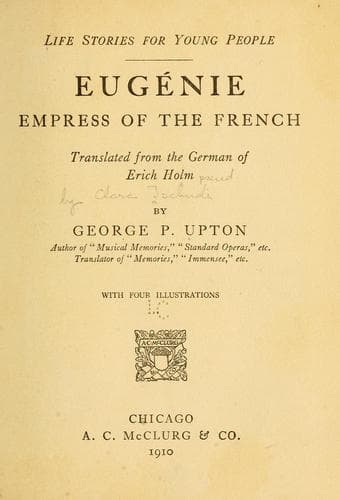
Eugénie, Empress, consort of Napoleon III, Emperor of the French, 1826-1920; Napoleon III, Emperor of the French, 1808-1873 -- Marriage
Her jewels and dresses, with some ready money that was found in the
Tuileries after her flight, were sent to her in England. Yet although
she was forced to dispose of her diamonds to defray necessary expenses;
and although Napoleon, to provide himself with funds, sold his private
estate in Rome, the “Palazzo dei Cesari,” for a few hundred thousand
francs, it was persistently asserted in Paris that the imperial family
were in possession of millions of francs with which they had enriched
themselves at the people’s expense; also that Napoleon had made enormous
sums in foreign speculation and owned capital in Dutch, English, and
American bonds.
Filled with anger and despair at these lies and petty persecutions,
Eugénie found life at Hastings unendurable. The prying curiosity of the
townspeople and of the crowds of strangers that flocked thither was a
torment to her. Even the sea air she so loved did her no good; the
magnificent view only served to rouse bitter memories of the happy days
at Biarritz. The King of Prussia had offered her and her son a residence
in Wilhelmshöhe, but she would accept no hospitality from France’s
enemy. At length, through Dr. Evans, she rented Camden House at
Chiselhurst, whither she moved toward the end of September.
But even though dethroned and an exile, Eugénie did not altogether cease
to concern herself with politics. While she was at Hastings, and the
situation following her flight was so new as still to warrant
recognition of her authority as Regent, Bismarck sent an envoy to her to
discuss terms of peace. She replied that so long as there remained a
single enemy on French soil, or there was question of even the smallest
cession of territory, she would enter into no negotiations with him.
Bismarck was not the only one who tried to induce her to intervene in
this matter. There was still one post in France that held out against
the Germans, still one general at least who was loyal to the Empire.
Marshal Bazaine was in Metz with a force of 170,000 men, all picked
troops, including the Imperial guard which had so often filled the
Parisian populace with pride at state reviews. Believing himself strong
enough to exert some influence over the question of peace or a
continuation of hostilities, he sent General Bourbaki to Chiselhurst,
with the consent of the King of Prussia, to inform the Empress that he
was in favor of concluding peace if she would so authorize him. Tempting
as this opportunity of again wielding power was to Eugénie’s active
nature, she prudently forbore, realizing that her best plan was to
withdraw entirely from the field of politics at present and await a more
favorable opportunity, when she might work with redoubled energy for the
restoration of her family. This course was also in accordance with the
wishes of Napoleon, to whom she made a secret visit in October in order
to consult with him, while General Bourbaki was at Chiselhurst awaiting
an answer.
Public-domain text, read in full here on John Shaqi.
Reviews
Reviews
No reviews yet
Be the first to share your thoughts on this work.
Elsewhere in the archive
Join the Discussion
Join the discussion
Sign in to leave a comment or review.
Sign InorCreate an account