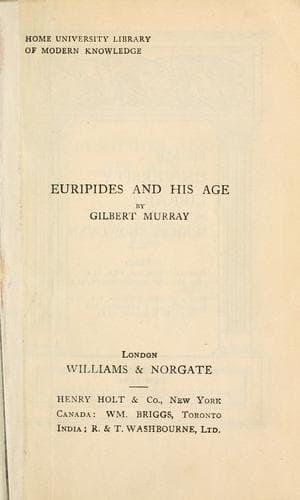
Euripides -- Criticism and interpretation; Mythology, Greek, in literature; Tragedy
This dance gradually grew into drama; how it did so is an old story.
Into the inarticulate mass of emotion and dumb show which is the Dance
there comes some more articulate element. There comes some one who
relates, or definitely enacts, the actual death or "pathos" of the hero,
while the Chorus goes on as before expressing emotion about it. This
emotion, it is easy to see, may be quite different from that felt by the
Hero. There is implied in the contemplation of any great deed this
ultimate emotion, which is not as a rule felt by the actual doers of it,
and is not, at its highest power, to be expressed by the ordinary
language of dialogue. The dramatist may make his characters express all
that they can properly feel; he may put into articulate dialogue all
that it will bear. But there still remains some residue which no one on
the stage can personally feel and which can only express itself as music
or yearning of the body. This residue finds its one instrument in the
Chorus.
Imagine the death of some modern hero, of Lincoln or of Nelson, treated
in the Greek form. We should have first a Messenger bringing news of the
battle of Trafalgar or the pistol-shot in the Washington Theatre. The
hero would be borne in dying; his friends would weep over him; we should
hear his last words. But there would always remain some essential
emotion or reflection--sadness, triumph, pathos, thoughts of the future
from which this man will be lacking or of the meaning of this death in
human history: neither Lincoln nor Nelson can express this, nor without
falsity any of their human companions. In a novel the author can express
it; in a modern play or a severely realistic novel it is generally not
expressed except by a significant silence or some symbol. For realistic
work demands extreme quickness in its audience, and can only make its
effect on imaginations already trained by romance and idealism. On the
Greek stage the Chorus will be there just for this purpose, to express
in music and movement this ultimate emotion and, as Mr. Haigh puts it,
to "shed a lyrical splendour over the whole." It will translate the
particular act into something universal. It will make a change in all
that it touches, increasing the elements of beauty and significance and
leaving out or reducing the element of crude pain. This is nothing
extraordinary: it is the normal business of poetry, at least of great
tragic poetry. An actual bereavement is an experience consisting of
almost nothing but crude pain; when it is translated into religion or
poetry, into "Rachel weeping for her children," or into "Break, break,
break," it has somehow become a thing of beauty and even of comfort.
Public-domain text, read in full here on John Shaqi.
Reviews
Reviews
No reviews yet
Be the first to share your thoughts on this work.
Elsewhere in the archive
Join the Discussion
Join the discussion
Sign in to leave a comment or review.
Sign InorCreate an account