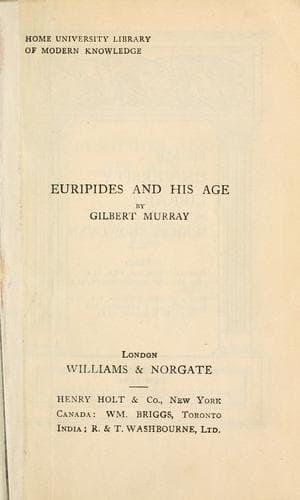
Euripides -- Criticism and interpretation; Mythology, Greek, in literature; Tragedy
_Another._
O miserable woman! O abhorred!
_Voice of a Child within._
What shall I do? What is it? Keep me fast
From Mother!
_The Other Child._
I know nothing. Brother! Oh,
I think she means to kill us.
_One of the Chorus._
Let me go!
I will!--Help, help! And save them at the last!
_Child._
Yes, in God's name. Help quickly or we die!
_The Other Child._
She has almost caught me now: she has a sword.
One sees the Women of the Chorus listening for the Children's words;
then they break, as it were, from the spell of their own super-mortal
atmosphere, and fling themselves on the barred door. They beat in vain
against the bars and the Children's voices cry for help from the other
side.
But the inrush of violent horror is only tolerated for a moment. Even in
the next words we are moving back to the realm of formal poetry:
_Women Beating at the Door._
Thou stone, thou thing of iron! Wilt verily
Spill with thine hand that life, the vintage stored
Of thine own agony?
_Others_
A woman slew her babes in days of yore,
One, only one, from dawn to eventide. . . .
and in a moment we are away in a beautiful remote song about far-off
children who have been slain in legend. That death-cry is no longer a
shriek heard in the next room. It is the echo of many cries of children
from the beginning of the world, children who are now at peace and whose
ancient pain has become part mystery and part music. Memory--that Memory
who was mother of the Muses--has done her work upon it.
We see here the justification of the high formalism and convention of
Greek tragedy. It can touch without flinching any horror of tragic life,
without failing in sincerity and without marring its normal atmosphere
of beauty. It brings things under the great magic of something which is
hard to name, but which I have tried in these pages to indicate;
something that we can think of as eternity or the universal or perhaps
even as Memory. For Memory, used in this way, has a magical power. As
Mr. Bertrand Russell has finely put it in one of his _Essays_, "The Past
does not change or strive. Like Duncan in _Macbeth_ 'After life's fitful
fever it sleeps well.' What was eager and grasping, what was petty and
transitory, has faded away. The things that were beautiful and eternal
shine out like stars in the night."
Public-domain text, read in full here on John Shaqi.
Reviews
Reviews
No reviews yet
Be the first to share your thoughts on this work.
Elsewhere in the archive
Join the Discussion
Join the discussion
Sign in to leave a comment or review.
Sign InorCreate an account