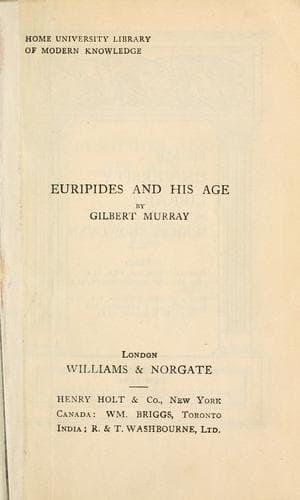
Euripides -- Criticism and interpretation; Mythology, Greek, in literature; Tragedy
In the same year as the _Andromeda_ came another romantic play, the
_Helena_. It is a good deal like the _Iphigenîa_ in structure, but it is
lighter, harder, and more artificial. The romance of Euripides is never
quite the easy dreaming of lighter-hearted writers. And the _Helena_, in
which he seems to have attempted a work of mere fancy, is, if we
understand it rightly, a rather brilliant failure. Some critics--quite
mistakenly in my judgment--have even argued that it is a parody. The
plot is based on a variant of the canonical legend about Helen, a
variant generally associated with the ancient lyric poet, Stesichorus.
Story tells that Stesichorus at one time lost his eyesight and took it
into his head that this was a punishment laid on him by the goddess
Helen, because he had told the story of her flight with Paris from her
husband's house. He wrote a recantation, based on another form of the
Helen-legend, in which Helen was borne away by the God Hermes to Egypt
and there lived like a true wife till Menelaus came and found her. The
being that went with Paris to Troy was only a phantom image of Helen,
contrived by the gods in order to bring about the war, and so reduce the
wickedness and multitude of mankind. In Euripides' play there is a
wicked king of Egypt, who seeks to marry Helen against her will and
kills all Greeks who land in his country. The war at Troy is over, and
Menelaus, beaten by storms out of his way, is shipwrecked on the coast
of Egypt. He and Helen meet, recognize one another, and by the help of
the king's sister, who has second sight, contrive to escape. It is hard
to say what exactly is wrong with the _Helena_; and it may only be that
we moderns do not know in what spirit to take it. But the illusion is
difficult to keep up and the work seems cold. Reality has gone out of
it. For one thing, Helen, in her thorough process of rehabilitation, has
emerged that most insipid of fancies, a perfectly beautiful and
blameless heroine with no character except love of her husband, whom, by
the way, she has not seen for seventeen years.
Public-domain text, read in full here on John Shaqi.
Reviews
Reviews
No reviews yet
Be the first to share your thoughts on this work.
Elsewhere in the archive
Join the Discussion
Join the discussion
Sign in to leave a comment or review.
Sign InorCreate an account