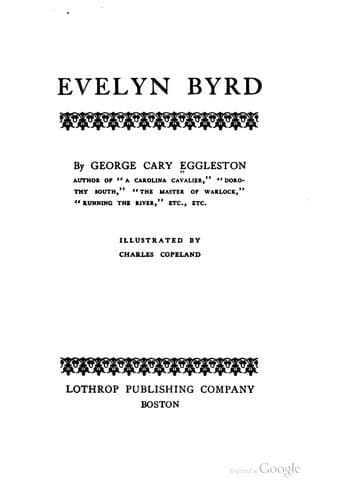
Virginia -- History -- Civil War, 1861-1865 -- Fiction
“Now, while I had, myself, no right to say whether or not you should
read those papers, and while it was not my privilege to protect you
against any distress they might bring to you, I still have a good deal
of apprehension lest their reading shall needlessly wound you. I am
going to make a suggestion, therefore, which I hope you will take in
good part.”
“I am ashamed of myself,” answered Evelyn, “for making you feel in that
way. I am ashamed of what I said to you—though it was all true and
necessary—and of the way in which I said it. I wish I could explain
why I did it, why it hurt me so when you tried to conceal something
from me. My outbreak has hurt you, and almost humiliated you, I reckon,
and I don’t like to think of you being hurt and humiliated. It is good
and generous of you to try, as you have done, to spare me. Believe me
when I tell you that I feel it to have been so. I cannot explain, and
it vexes me that I must not. Won’t you believe that?”
“I believe anything you say, and everything you say. Indeed, it is more
than belief that I feel when you tell me anything; it is a conviction
of actual and positive knowledge. And now I very much want you to
believe me when I say that it was not your ‘outbreak,’ as you call it,
that hurt and humiliated me. It was only my consciousness of my own
presumptuous impertinence that hurt. I have nothing to forgive in you;
and my own fault I cannot forgive.”
There were tears in Evelyn’s eyes as the strong and generous man who
had been so careful of her said this, shielding her even now by taking
all blame upon himself, just as he had shielded her long before by
keeping his own person between her and the bullets that were raining
about them. For the moment the old childlike simplicity came into her
bearing. She advanced, took Kilgariff’s hand, and said:—
“Let’s forget all about it, please. You have always been good to me.”
Then the dignity came back, and, resuming her seat, she said:—
“You were going to offer a suggestion. I should like to hear it. I am
sure it is meant for my advantage.”
“It is only this: I have a haunting fear that your father—”
“He was not my father,” the young woman broke in, speaking the words
quite as if they had borne no special significance. “But go on, please.”
Kilgariff almost lost the thread of his thought in his astonishment at
this sudden statement. He went on:—
Public-domain text, read in full here on John Shaqi.
Reviews
Reviews
No reviews yet
Be the first to share your thoughts on this work.
Elsewhere in the archive
Join the Discussion
Join the discussion
Sign in to leave a comment or review.
Sign InorCreate an account