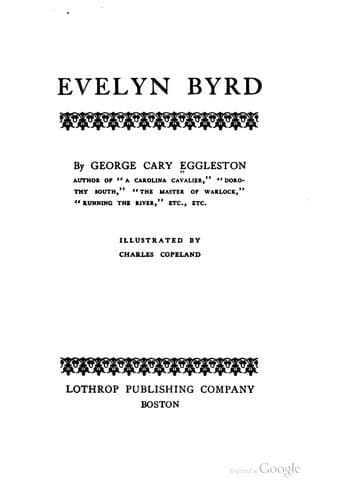
Virginia -- History -- Civil War, 1861-1865 -- Fiction
In this matter of guns, as well as in numbers of men, the Federals had
enormous advantage. They had arsenals and foundries equipped with the
most improved machinery to supply them, and they could draw freely
upon the armouries of Europe, besides. The Confederates had no such
resources. The few and small shops within their command were antiquated
in their equipment and very sharply limited in their capacity. But they
did their best.
As soon as regular siege operations began, the Federals set to work
establishing mortar batteries at every available point. Mortars are
very short guns fired at a high “elevation”; that is, pointing upward
at an angle of forty-five degrees to the horizon, or more than that, so
as to throw shells high in air and let them fall perpendicularly upon
an enemy’s works, breaking down defences and reaching points in rear of
works to which ordinary cannon fire cannot penetrate.
The lines were so close together—at one point only fifty yards
apart—that everything had to be done under cover of some kind, and
thus mortars became a vitally necessary arm with which to break down
the enemy’s cover. The Confederates had none of these guns at first,
but their foundries were at least capable of manufacturing so simple
a weapon in a rude but effective fashion, making the mortars of iron
instead of brass, and mounting them in oaken blocks heavily banded
with wrought iron. In a very brief time the mortars began to arrive,
and their numbers rapidly increased, but there were very few of the
officers who knew how to handle a weapon so wholly different from
ordinary guns both in construction and in methods of use.
This scarcity of mortar-skilled officers in the lower grades gave Owen
Kilgariff his opportunity. The thought occurred to him suddenly on the
day after his vigil, and he acted upon it at once.
He wrote to Arthur Brent, addressing his letter to Wyanoke, whence it
would of course be forwarded should Doctor Brent be at Petersburg still.
I want you, Arthur [he wrote], to use your influence in my behalf
in a matter that touches me closely. For several reasons I want to
be ordered from this place to Petersburg. For one thing, there is a
matter of business, vitally interesting to you and me and closely
involving the welfare of others. I simply must see you concerning it
without delay. If I can get to Petersburg, I can see you, for Wyanoke
is near enough to the beleaguered city for you to visit me in the
trenches. There are other reasons, but the necessity of seeing you is
the most important and the least personal to myself, so I need not
bother you now with the other considerations that move me to desire
this change, which you can bring about if you will—and I am sure you
will.
Public-domain text, read in full here on John Shaqi.
Reviews
Reviews
No reviews yet
Be the first to share your thoughts on this work.
Elsewhere in the archive
Join the Discussion
Join the discussion
Sign in to leave a comment or review.
Sign InorCreate an account