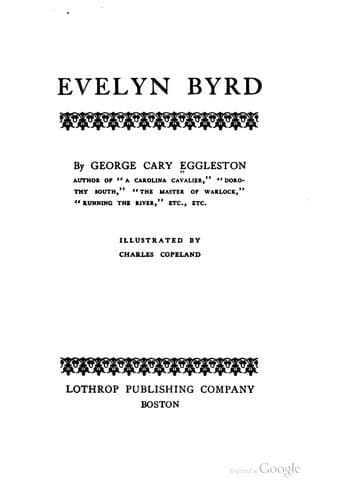
Virginia -- History -- Civil War, 1861-1865 -- Fiction
All these things are only incidents illustrative of that heroism on the
part of women which the poet, if we had a poet, would seize upon as
the vital and essential story of the Confederate war. If that heroism
could be properly celebrated, it would make a literature worthy to
stand shoulder to shoulder with the hero-songs of old Homer himself.
But that story of woman’s love and woman’s sacrifice has never been
told and never will be, for the reason that there is none worthy to
tell it among those of us who survive of those who saw it and knew the
self-sacrificing absoluteness of its heroism.
Into all this work of mercy Evelyn Byrd entered not only with
enthusiasm, but with the tireless energy of healthy youth and with a
queer sagacity—born, perhaps, of her strange life-experience—which
enabled her sometimes to double or quadruple the beneficent effects of
her work by the deftness of its doing.
Her enthusiasm in the cause rather astonished Dorothy, at first. If
the girl had been brought up in Virginia, if her home had always been
there, if she had had a people of her own there, with a father and a
brother in the trenches, her devotion would have been natural enough.
But none of those reasons for her enthusiasm existed. She had probably
been born in Virginia, or at least of Virginian parentage, though even
that assumption rested upon no better foundation than the fact that
she bore a historic Virginian name. She had lived elsewhere during
her childhood and youth. She had come into the Southern country under
compulsion, and three fourths of the war was over before she came. So
far as she knew, she had no relatives in Virginia, and very certainly
she had none there whom she knew and loved.
Yet she was passionate almost to madness in her Virginianism, and she
was self-sacrificing even beyond the standards of the other heroic
women around her.
That she should enter passionately into any cause into which she
enters at all [wrote Dorothy to Arthur during one of his absences
at the front] is altogether natural. Her nature is passionate in an
extreme degree, and, good as her judgment is when it is cool, she
sends it about its business whenever it assumes to meddle with her
passionate impulses. She has certain well-fixed principles of conduct,
from which she never departs by so much as a hair’s breadth—chiefly,
I imagine, because they are principles which she has wrought out
in her mind without anybody’s teaching or anybody’s suggestion.
They are the final results of her own thinking. She regards them as
ultimates of truth. But subject to these, she is altogether a creature
of impulse. Even to save one she loves from great calamity, she
would not think of compromising the most trivial of her fundamental
principles; yet for the sake of one she loves, she would sacrifice
herself illimitably even upon the most trivial occasion. It is a
dangerous character to possess, but a most interesting one to study,
and certainly it is admirable.
Public-domain text, read in full here on John Shaqi.
Reviews
Reviews
No reviews yet
Be the first to share your thoughts on this work.
Elsewhere in the archive
Join the Discussion
Join the discussion
Sign in to leave a comment or review.
Sign InorCreate an account