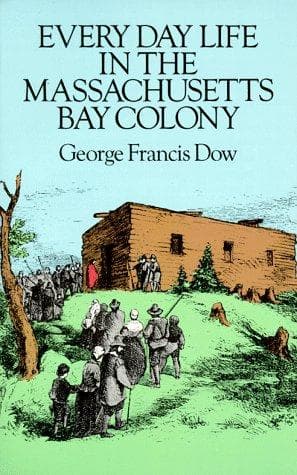
Every Day Life in the Massachusetts Bay ColonyDow, George Francis
History
Every Day Life in the Massachusetts Bay Colony
Dow, George Francis
Massachusetts -- Social life and customs -- To 1775
In Salem lived Zerobabel Endecott, son of Governor John Endecott,
who practiced the healing art and who left behind him a remarkable
collection of medical recipes from which we include selections
illustrating the practice of the physician in colonial days. His
brother John, afterwards Governor of Connecticut, also seems to have
had some medical training as appears from a bill preserved in the
Massachusetts Archives, where under date of 1668, he charged five
shillings for "a Vomit and atendans" on one John Clark, "weak and
sike by reason of a scurvy and a dropsy." Doctor Zerobabel died in
1684 and bequeathed to his son John, who also was a physician and
who died in England, "al my Instruments and books both of phisicke
and chirurgery." The inventory of the estate shows "a case of
lances, 2 Rasors, a box of Instruments, 10 bookes in folio, 16 in
quarto, a saw with six Instruments for a chirurgion and a chest of
bookes & writings."
Other Salem physicians were George Emery who settled in the town in
1636 and sat on the gallows with a rope around his neck, in 1668,
for an unnatural crime; Rev. John Fiske, a graduate of Cambridge,
who had studied divinity and also physic, and came to Salem in
1637; and Daniel Weld, who was chief surgeon during the Narraganset
campaign in King Philip's War; Col. Batholomew Gedney, who left at
his death drugs and instruments inventoried at £60; Dr. John Barton,
who died of yellow fever; Dr. John Swinnerton, made famous by
Hawthorne's romance, and others followed.
William Salmon, in his "Compendium of Physick," published in
London in 1671, estimates the necessary qualifications of the
seventeenth-century physician as follows: "He that would be an
accomplished physician, ought to be furnished with three things,
1. honesty and a good conscience; 2. a substantial, real, and
well-grounded understanding through the whole Art of Medicine; 3.
with all such Instruments and Necessaries which are ordinarily made
use of in the performance of any medical operation," and these
instruments are listed as follows:
"The Parascuological Instruments, wherewith medicines are prepared,
whether Galenical or Chymical, are chiefly these: A brass Kettle; an
Alembick; a Circulatory; a Sieve; a Gourd; a Balneum Mariae; Tongs;
a Cauldron; a File; a Hippocras Bag; an Iron Mortar; a Pestle;
a Pitcher; a Marble; a glass Mortar and Pestle; a Seperator; a
Funnel; a Seirce; a Press; a Tile; a pair of Sheers; Vials; Boxes;
Crucibles; Gally-pots; Corks; Spoons; Strainers; Retorts; Receivers;
Bags; Spatulas; Weights and Scales; together with a Pair of
Goldsmiths Bellows; and convenient Furnaces fitted for any operation.
Public-domain text, read in full here on John Shaqi.
Reviews
Reviews
No reviews yet
Be the first to share your thoughts on this work.
Elsewhere in the archive
Join the Discussion
Join the discussion
Sign in to leave a comment or review.
Sign InorCreate an account