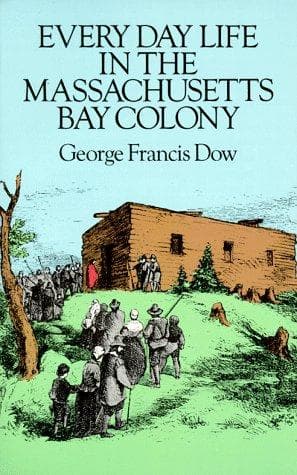
Every Day Life in the Massachusetts Bay ColonyDow, George Francis
History
Every Day Life in the Massachusetts Bay Colony
Dow, George Francis
Massachusetts -- Social life and customs -- To 1775
This code, known as "the Body of Liberties," comprised about one
hundred laws, civil and criminal. The civil laws were far in
advance of the laws of England at that time, and in substance were
incorporated in every subsequent codification of the laws of the
Colony. Some of them are in force today, and others form the basis
of existing laws. The criminal laws were taken principally from the
Mosaic code and although many of them may seem harsh and cruel yet,
as a whole, they were much milder than the criminal laws of England
at that time. No reference was made to the common law of England.
All legislation in regard to offences was based upon the Bible, and
marginal references to book, chapter and verse were supplied to
guide future action. This Code served its intended purpose well and
remained in force until the arrival of the Province charter in 1692
save during the short period of the Andros administration.
The judiciary system of the Colony therefore provided for the
following courts:
First, the Great and General Court which possessed legislative
powers and limited appellate authority from the Court of Assistants.
Second, the Court of Assistants--a Supreme Court or Court of Appeals
that had exclusive jurisdiction in all criminal cases extending "to
life, limb, or banishment," jurisdiction in civil cases in which the
damages amounted to more than £100., and appellate jurisdiction from
the County Quarterly Courts.
Third, County or Inferior Quarterly Courts that had jurisdiction
in all cases and matters not reserved to the Court of Assistants
or conferred upon commissioners of small causes. These courts also
laid out highways, licensed ordinarys, saw that an able ministry was
supported, and had general control of probate matters, and in 1664
were authorized to admit freemen.
The juries were made judges of the law and the fact and when upon
a trial there was insufficient evidence to convict, juries were
authorized to find that there were strong grounds of suspicion, and
accordingly sentence afterwards was given by the Court. In order to
facilitate court proceedings an excellent law was passed in 1656
which authorized the fining of a person 20 shillings an hour for any
time occupied in his plea in excess of one hour.
John Winthrop with his company arrived at Salem in June, 1630,
and ten weeks later the first court in the Colony was held at
Charlestown. The maintenance of the ministry was the first concern,
to be followed by an order regulating the wages of carpenters,
bricklayers, thatchers and other building trades. Thomas Morton
at "Merry Mount" was not forgotten for he was to be sent for "by
processe," and a memorandum is entered to obtain for the next Court
an estimate "of the charges that the Governor hathe beene att in
entertaineing several publique persons since his landing in Newe
England."
Public-domain text, read in full here on John Shaqi.
Reviews
Reviews
No reviews yet
Be the first to share your thoughts on this work.
Elsewhere in the archive
Join the Discussion
Join the discussion
Sign in to leave a comment or review.
Sign InorCreate an account