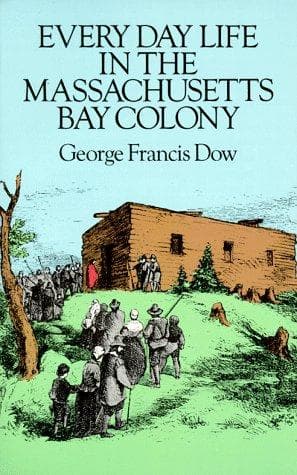
Every Day Life in the Massachusetts Bay ColonyDow, George Francis
History
Every Day Life in the Massachusetts Bay Colony
Dow, George Francis
Massachusetts -- Social life and customs -- To 1775
At the Superior Court held in Cambridge last week, one Hannah Dudley
of Lincoln was convicted of repeatedly commiting Adultery and
Fornication with her own Mother's husband, an old Man of 76 years of
age. She was sentenced to be set upon the Gallows for the space of
one Hour, with a Rope about her Neck, and the other end cast over
the Gallows, and in the way from thence to the Common Goal, that she
be severely whipped 30 stripes, and that she for ever after wear a
Capital I of two inches long and proportionable bigness cut out in
Cloth of a different Colour to her Cloaths, and sewed upon her upper
Garment on the outside of her arm, or on her Back, in Open View. [No
further mention is made of the step-father.]--_Boston News-Letter_,
Aug. 16, 1759.
Massachusetts did not purge her laws from these ignominous
punishments until 1813 when whipping, branding, the stocks, the
pillory, cutting off ears, slitting noses, boring tongues, etc.,
were done away with.
There lived in Salem, nearly three centuries ago, a woman whose
story is told by Governor Winthrop and the records of the Quarterly
Courts. She was, in a sense, a forerunner of Anne Hutchinson and we
may fancy at heart a suffragette. Her story gives you an outline
picture of the manners of the times in a few details. Her name
was Mary Oliver and her criminal record begins in June, 1638.
Governor Winthrop relates: "Amongst the rest, there was a woman in
Salem, one Oliver, his wife, who had suffered somewhat in England
by refusing to bow at the name of Jesus, though otherwise she was
conformable to all their orders. She was (for ability of speech,
and appearance of zeal and devotion) far before Mrs. Hutchinson,
and so the fitter instrument to have done hurt, but that she was
poor and had little acquaintance. She took offence at this, that she
might not be admitted to the Lord's supper without giving public
satisfaction to the church of her faith, etc., and covenanting or
professing to walk with them according to the rule of the gospel; so
as upon the sacrament day she openly called for it, stood to plead
her right, though she were denied; and would not forbear, before
the magistrate, Mr. Endecott, did threaten to send the constable to
put her forth. This woman was brought to the Court for disturbing
the peace in the church, etc., and there she gave such premptory
answers, as she was committed till she should find surities for her
good behavior. After she had been in prison three or four days, she
made means to the Governor and submitted herself, and acknowledged
her fault in disturbing the church; whereupon he took her husband's
bond for her good behavior, and discharged her out of prison. But
he found, after, that she still held her former opinions, which
were very dangerous, as, (I) that the church is the head of the
people, both magistrates and ministers, met together and that these
have power to ordain ministers, etc. (II) That all that dwell in
Public-domain text, read in full here on John Shaqi.
Reviews
Reviews
No reviews yet
Be the first to share your thoughts on this work.
Elsewhere in the archive
Join the Discussion
Join the discussion
Sign in to leave a comment or review.
Sign InorCreate an account