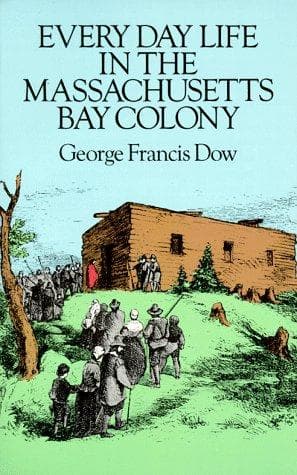
Every Day Life in the Massachusetts Bay ColonyDow, George Francis
History
Every Day Life in the Massachusetts Bay Colony
Dow, George Francis
Massachusetts -- Social life and customs -- To 1775
Capt. Samuel Bellamy, in the pirate ship _Whydah_, was wrecked
on Cape Cod near Wellfleet, the spring of 1717, and 142 men were
drowned. Six pirates who reached shore were tried in Boston and
sentenced to be hanged "at Charlestown Ferry within the flux and
reflux of the Sea." After the condemned were removed from the
courtroom the ministers of the town took them in hand and "bestowed
all possible '_Instructions_ upon the Condemned Criminals; often
_Pray'd_ with them; often _Preached_ to them; often _Examined_ them;
and _Exhorted_ them; and presented them with Books of Piety.'" At
the place of execution, Baker and Hoof appeared penitent and the
latter joined with Van Vorst in singing a Dutch psalm. John Brown,
on the contrary, broke out into furious expressions with many oaths
and then fell to reading prayers, "not very pertinently chosen,"
remarks the Rev. Cotton Mather. He then made a short speech, at
which many in the assembled crowd trembled, in which he advised
sailors to beware of wicked living and if they fell into the hands
of pirates, to have a care what countries they came into. Then the
scaffold fell and six twitching bodies, outlined against the sky,
ended the spectacle.
In 1724 the head of Capt. John Phillips, the pirate, was brought
into Boston in pickle. He had been killed by "forced men" who had
risen and taken the pirate ship. Only two of his company lived to
reach Boston for trial and execution, and one of them, John Rose
Archer, the quartermaster, was sentenced to be "hung up in Irons, to
be a spectacle, and so a Warning to others." The gibbet was erected
on Bird Island which was located about half-way between Governor's
Island and East Boston. In the Marshal's bill for expenses in
connection with the execution appears the following item:
"To Expenses for Victuals and Drink for the Sherifs, Officers and
Constables after the Executions att Mrs. Mary Gilberts her Bill
£3.15.8."
The enforcement of the English statute relating to piracy was
variously interpreted in the Colonial courts, and local enactments
sometimes superseded it in actual practice. Previous to 1700,
the statute required that men accused of piracy should be sent
to England to be tried before a High Court of Admiralty. Pound,
Hawkins, Bradish, Kidd, and other known pirates were accordingly
sent in irons to London for trial. But the difficulties and delays,
to say nothing of the expense, induced Parliament by an Act of 11
and 12 William III, to confer authority by which trials for piracy
might be held by Courts of Admiralty sitting in the Colonies. On the
other hand, the Massachusetts Court of Assistants in 1675 found John
Rhoades and others, guilty of piracy. This was in accordance with an
order adopted by the Great and General Court on October 15, 1673.
When Robert Munday was tried at Newport, R. I., in 1703, it was by a
jury in the ordinary criminal court, in open disregard of the King's
commission.
Public-domain text, read in full here on John Shaqi.
Reviews
Reviews
No reviews yet
Be the first to share your thoughts on this work.
Elsewhere in the archive
Join the Discussion
Join the discussion
Sign in to leave a comment or review.
Sign InorCreate an account