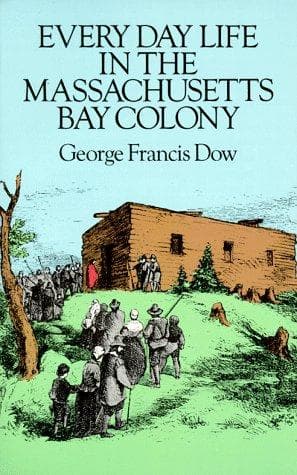
Every Day Life in the Massachusetts Bay ColonyDow, George Francis
History
Every Day Life in the Massachusetts Bay Colony
Dow, George Francis
Massachusetts -- Social life and customs -- To 1775
The minister at Ipswich grew so ill-tempered over the ungodly state
of the women in his town that he vented his spleen as follows:
"When I hear a nugiperous Gentledame inquire what dress the Queen
is in this week, what the nudius tertian of the Court, I look at
her as the very gizzard of a trifle, the product of a quarter of a
cypher, the epitome of nothing, fitter to be kickt, if she were of a
kickable substance than either honoured or humoured."[32]
[32] Ward, _The Simple Cobler of Aggawam_, London, 1647.
The minister in the adjoining town, Rowley, actually cut off his
nephew from his inheritance because he wore his hair long in the
prevailing fashion. Later in the century the offense of wearing
long hair was forgotten in the unspeakable sin of wearing wigs. The
Great and General Court again took a hand and in 1675 condemned
"the practise of men's wearing their own or other's hair made into
periwigs." Judge Sewall in his _Diary_ alludes to the custom. In
1685 three persons were admitted to the Old South Church in Boston.
"Two wore periwigs," comments the Judge.
"1708, Aug. 20, Mr. Chievar died. The Wellfare of the Province was
much upon his Spirit. He abominated Periwigs."[33]
[33] _Sewall's Diary_, Vol. II, p. 231.
The Great and General Court at one time ordered that no person
should smoke tobacco in public under a penalty of two shillings
and six pence, nor in his own house with a relative or friend. But
everybody smoked who wanted to, even the maids, and the repressive
legislation in time met the usual fate of similar efforts to
restrain individual liberty and manners.
It is sweet to fancy Priscilla at her spinning wheel wearing the
coif and nun-like garb of the Puritan maiden of the poet and the
artist. But the inventories of estate in the early years of the
Colony, as well as at a later time, furnish evidence of a different
character. The variety of fabrics listed is amazing and holds
its own with the modern department store. There are most of the
well-known fabrics of today, such as calico, cambric, challis,
flannel, lawn, linen, plush, serge, silk, velvet, and many others;
and there are also names that sound strangely in modern ears, viz.:
cheney, darnex, dowlas, genting, inckle, lockrum, ossembrike,
pennistone, perpetuana, sempiternum, stammell, and water paragon.
As for dress--the women wore bonnets, caps, silk hoods, coifs,
forehead cloths, ruffs, and whisks. Gowns, cloaks, mantles, and
muffs are mentioned frequently; as are many kinds of lace and
even fans and veils. Shawls and scarfs were not unknown and there
were gold, silver, and enamelled rings. Women possessed masks, and
stomachers were not uncommon. Tortoise shell combs appear; all
well-to-do persons wore gloves, and as for shoes--there were shoes
with French heels, fall shoes, and those with silver buckles. Even
shoe strings appear in the inventories. There were silver, pewter,
and steel buttons and those of gympe, thread, and silk.
Public-domain text, read in full here on John Shaqi.
Reviews
Reviews
No reviews yet
Be the first to share your thoughts on this work.
Elsewhere in the archive
Join the Discussion
Join the discussion
Sign in to leave a comment or review.
Sign InorCreate an account