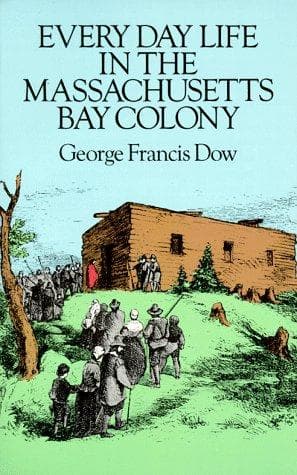
Every Day Life in the Massachusetts Bay ColonyDow, George Francis
History
Every Day Life in the Massachusetts Bay Colony
Dow, George Francis
Massachusetts -- Social life and customs -- To 1775
In the town of Ipswich, lived Madam Rebecka Symonds, writing in
her sixtieth year to her son in London to send her a fashionable
"lawn whiske," for her neckwear. In due time he replied that the
"fashionable Lawn whiske is not now worn, either by Gentil or
simple, young or old. Instead where of I have bought a shape and
ruffles, which is now the ware of the gravest as well as the young
ones. Such as goe not with naked necks ware a black wifle over it.
Therefore, I have not only Bought a plaine one y't you sent for, but
also a Luster one, such as are most in fashion."
The dutiful son also purchased for his mother's wear a feather fan;
but he writes to her "I should also have found in my heart, to have
let it alone, because none but very grave persons (and of them very
few) use it. Now 'tis grown almost as obsolete as Russets, and more
rare to be seen than a yellow Hood." When the feather fan reached
Ipswich it was found to have a silver handle and with it came "two
tortois fans, 200 needles, 5 yds. sky calico, silver gimp, a black
sarindin cloak, damson leather skin, two women's Ivorie Knives,
etc."[30]
[30] Waters, _Ipswich in the Massachusetts Bay Colony_, Ipswich,
1905.
Human nature and human frailities were much the same in the
seventeenth century as at the present time, and before long, the
magistrates considered it desirable to curb the extravagancies
of dress that followed the London mode; and to induce a spirit
of economy more fitting to the poverty of a new settlement. The
ministers controlled the lawmaking body and sumptuary laws were
enacted which are enlightening. Because of "newe and immodest
fashions" the wearing of silver, gold and silk laces, girdles and
hat bands was prohibited. It was the fashion at that time to slash
the sleeves so that a fabric of another color worn beneath would
show in an ornamental manner through the slash. The ministers
decreed that neither man nor woman should wear clothing with more
than one slash on each sleeve and another on the back. "Cutt-works,
inbroidered or needle worke capps, bands & rayles," were
forbidden.[31] Ruffs and beaver hats were prohibited, as was long
hair. Binding or small edging laces might be used, but the making or
selling of bone lace was penalized at the rate of five shillings per
yard.
[31] _Records of the Mass. Bay Colony_, Vol. I, p. 126.
But this didn't change human nature and although from time to time
offenders were taken into court and punished, the wearing of fine
clothing fashioned after the London mode continued and a few years
later the ministers tried their hand again. Any kind of lace was
anathema and "no garment shalbee made with short sleeves, whereby
the nakedness of the arme may bee discovered." On the other hand,
large sleeves were forbidden, so the maids and goodwives of the time
must have been somewhat at a loss to know how lawfully to fashion
their clothes.
Public-domain text, read in full here on John Shaqi.
Reviews
Reviews
No reviews yet
Be the first to share your thoughts on this work.
Elsewhere in the archive
Join the Discussion
Join the discussion
Sign in to leave a comment or review.
Sign InorCreate an account