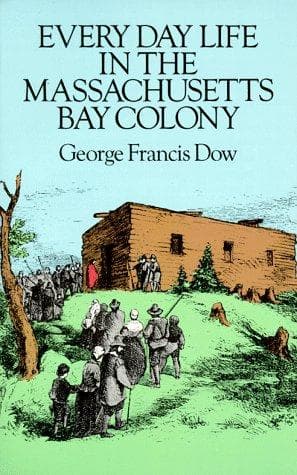
Every Day Life in the Massachusetts Bay ColonyDow, George Francis
History
Every Day Life in the Massachusetts Bay Colony
Dow, George Francis
Massachusetts -- Social life and customs -- To 1775
_Calamanco_, _Callimancoe_. A woolen stuff of Flanders, glossy on
the surface, and woven with a satin twill and checkered in the
warp, so that the checks are seen on one side only; much used in
the eighteenth century. Calamanco breeches (1605), diamond buttoned
callamanco hose (1639). His waistcoat of striped calamanco (1693). A
gay calamanco waistcoat (1710). A tawny yellow jerkin turned up with
red calamanco (1760).
_Calico._ Originally a general name for all kinds of cotton cloth
imported from Callicut, India, and from the East. Painted calicuts
they call calmendar (1678). Pepys bought calico for naval flags
(1666). Dressed in white cotton or calico (1740).
_Cambletteens._ Boston News-Letter, Dec. 18, 1760.
_Camlet._ Originally made of silk and camel's hair, hence the name,
but later of silk and wool. Red chamlett (1413). His camlet breeches
(1625). Rich gold or silver chamlets (1634). Watering the grograms
and chambletts (1644). Pepy owned a camelott riding coat (1662).
Camlet was also made with a wavy or watered surface. Water Chamolet
of an azure color (1624). A watered camlet gown (1719).
_Camleteen._ An imitation camlet. Made of fine worsted (1730).
_Cantaloon._ A woolen stuff manufactured in the eighteenth century
in the west of England. Trusses of cantaloons or serges (1711).
Cantaloons from Bristol (1748).
_Canvas._ (1) Strong or coarse unbleached cotton cloth made of hemp
or flax, formerly used for clothing. A coverlet lined with canvas
(1537). (2) The thin canvas that serves women for a ground unto
their cushions or purse work (1611). Working canvas for cushions
(1753). St. Peter's Canvas.
_Carpet._ Originally a thick fabric, commonly of wool, used to cover
tables, beds, etc. Lay carpets about the bed (1513). A carpet of
green cloth for a little folding table (1527). A table wanting a
carpet (1642). A green carpet for the communion table (1702).
_Carsey_, see _Kersey_.
_Castor._ Generally a hat, either of beaver fur or resembling it.
_Challis._ A fine silk and worsted fabric, very pliable and without
gloss, used for dresses, introduced at Norwich, England, about 1632.
_Checks._ A fabric woven or printed in a pattern forming small
squares, i.e., check Kersey. Hungarian checks.
_Cheercoones._ Boston Gazette, June 23, 1729.
_Cheese Cloth._
_Chello._ A fabric imported from India in the eighteenth century.
_Cheney_, _Cheyney_. A worsted or woolen stuff. My red bed of
Phillipp and Cheyney (1650). Colchester cheanyes (1668).
_Cherry derries._ Boston News-Letter, Dec. 18, 1760.
_Coifing Stuff._ 3 yards, 3/4. Essex Co. (Mass.) Probate (1661).
_Copper plate._ A closely woven cotton fabric on which patterns,
landscapes, pictorial representations have been printed from
engraved copper plates; much in fashion during the eighteenth and
early nineteenth centuries.
_Dakaple_, see _Dornick_.
_Darnacle_, see _Dornick_.
_Darnex_, see _Dornick_.
_Dianetts._ Boston Gazette, Aug. 22, 1757.
Public-domain text, read in full here on John Shaqi.
Reviews
Reviews
No reviews yet
Be the first to share your thoughts on this work.
Elsewhere in the archive
Join the Discussion
Join the discussion
Sign in to leave a comment or review.
Sign InorCreate an account