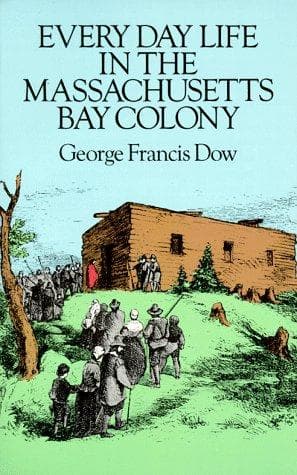
Every Day Life in the Massachusetts Bay ColonyDow, George Francis
History
Every Day Life in the Massachusetts Bay Colony
Dow, George Francis
Massachusetts -- Social life and customs -- To 1775
_Sempiternum._ A woolen cloth made in the seventeenth century and
similar to perpetuana. See _Everlasting_.
_Shag._ A cloth having a velvet nap on one side, usually of worsted,
but sometimes of silk. Crimson shag for winter clothes (1623). A
cushion of red shag (1725).
_Shalloon._ A closely woven woolen material used for linings.
Instead of shalloon for lining men's coats, sometimes use a glazed
calico (1678).
_Sleazy._ An abbreviated form of silesia. A linen that took its name
from Silesia in Hamborough, and not because it wore sleasy (1696). A
piece of Slesey (1706).
_Soosey._ A mixed, striped fabric of silk and cotton made in India.
Pelongs, ginghams and sooseys (1725).
_Stammel._ A coarse woolen cloth, or linsey-woolsey, usually
dyed red. In summer, a scarlet petticoat made of stammel or
linsey-woolsey (1542). His table with stammel, or some other carpet
was neatly covered (1665). The shade of red with which this cloth
was usually dyed was called stammel color.
_Swanskin_, _Swanikins_. A fine, thick flannel, so called on account
of its extraordinary whiteness. The swan-skin coverlet and cambrick
sheets (1610).
_Tabby._ Named for a quarter of Bagdad where the stuff was woven. A
general term for a silk taffeta, applied originally to the striped
patterns, but afterwards applied also to silks of uniform color
waved or watered. The bride and bridegroom were both clothed in
white tabby (1654). A child's mantle of a sky-colored tabby (1696).
A pale blue watered tabby (1760). Rich Morrello Tabbies. (Boston
Gazette, March 25, 1734).
_Tabling._ Material for table cloths; table linen, Diaper for
tabling (1640). 12 yards tabling at 2/6 per yard. Essex Co. (Mass.)
Probate (1678).
_Tamarine._ A kind of woolen cloth. A piece of ash-colored wooley
Tamarine striped with black (1691).
_Tammy._ A fine worsted cloth of good quality, often with a glazed
finish. All other kersies, bayes, tammies, sayes, rashes, etc.
(1665). A sort of worsted-stuff which lies cockled (1730). Her dress
a light drab lined with blue tammy (1758). A red tammy petticoat
(1678). Strain it off through a tammy (1769).
_Tandem._ A kind of linen, classed among Silesia linens. Yard wide
tandems for sale (1755). Quadruple tandems (1783).
_Thick Sets._ A stout, twilled cotton cloth with a short very close
nap: a kind of fustian. A Manchester thickset on his back (1756).
_Ticklenburg._ Named for a town in Westphalia. A kind of coarse
linen, generally very uneven, almost twice as strong as osnaburgs,
much sold in England. About 1800 the name was always stamped on the
cloth.
_Tiffany._ A kind of thin transparent silk; also a transparent gauze
muslin, cobweb lawn. Shewed their naked arms through false sleeves
of tiffany (1645). Black tiffany for mourning (1685).
_Tow Cloth._ A coarse cloth made from tow, i.e., the short fibres of
flax combed out by the hetchell, and made into bags or very coarse
clothing. Ropes also were made of tow.
Public-domain text, read in full here on John Shaqi.
Reviews
Reviews
No reviews yet
Be the first to share your thoughts on this work.
Elsewhere in the archive
Join the Discussion
Join the discussion
Sign in to leave a comment or review.
Sign InorCreate an account