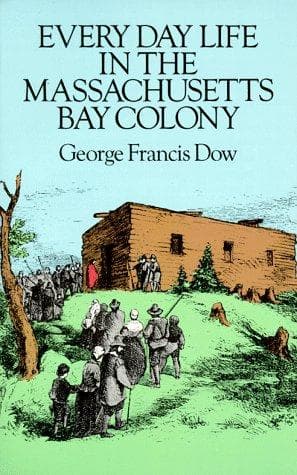
Every Day Life in the Massachusetts Bay ColonyDow, George Francis
History
Every Day Life in the Massachusetts Bay Colony
Dow, George Francis
Massachusetts -- Social life and customs -- To 1775
The widow Rebecca Bacon died in Salem in 1655, leaving an estate of
£195.8.6 and a well-furnished house. She had brass pots, skillets,
candlesticks, skimmers, a little brass pan, and an excellent supply
of pewter, including "3 large pewter platters, 3 a size lesse, 3
more a size lesse, 3 more a size lesse, £1.16; 1 pewter bason,
5s; 6 large pewter plates & 6 lesser, 9s; 19 Pewter saucers & 2
fruite dishes, 11s, 6d; 1 old Pewter bason & great plate, 3s; 2
pewter candlesticks, 4s; 1 large pewter salt & a smal one; 2 pewter
porringers, 3s.6d; 1 great pewter flagon; 1 lesser, 1 quart, 2 pints
& a halfe pint, 13s; 2 old chamber pots & an old porringer, 3s." She
also died possessed of "1 duble salt silver, 6 silver spones, 1 wine
cup & a dram cup of silver, both £6."
The Rev. James Noyes of Newbury, when he died in 1656, was possessed
of an unusually well-equipped kitchen, supplied with much brass
and ironware and the following pewter, viz.: "on one shelfe, one
charger, 5 pewter platters and a bason and a salt seller, £1.10.0;
on another shelfe, 9 pewter platters, small & great, 13 shillings;
one old flagon and 4 pewter drinking pots, 10 shillings." No pewter
plates or wooden trenchers are listed.
In other estates appear some unusual items, such as: a pewter brim
basin, pewter cullenders, pewter beer cups, pewter pans, pewter bed
pans, and a mustard pot.
The trade of the pewterer does not seem to have been followed by
many men in New England during the seventeenth century. The vessels
were bringing shipments from London and moreover, the bronze moulds
used in making the ware were costly. Pewter melted easily and
frequently required repairing, and it was here that the itinerant
tinker or second-rate pewterer found employment. The handles of
pewter spoons broke easily, and a spoon mould was a part of the
equipment of every tinker. The earliest mention we have noted of
the pewterer practising his trade in New England is one Richard
Graves of Salem. He was presented at a Quarterly Court on February
28, 1642-43 for "opression in his trade of pewtering" and acquitted
of the charge. Then he was accused of neglecting to tend the ferry
carefully, so it would seem that pewtering occupied only part of
his time. This he acknowledged, but said that he had not been put
to it by the Court and also that it was necessary to leave the
ferry when he went to mill, a quite apparent fact. He seems to have
been a somewhat reckless fellow in his dealings with neighbors, for
he was accused of taking fence rails from Christopher Young's lot
and admonished by the Court. At the same session he was fined for
stealing wood from Thomas Edwards and for evil speeches to him,
calling him "a base fellow, & yt one might Runn a half pike in his
bellie & never touch his hart."
Public-domain text, read in full here on John Shaqi.
Reviews
Reviews
No reviews yet
Be the first to share your thoughts on this work.
Elsewhere in the archive
Join the Discussion
Join the discussion
Sign in to leave a comment or review.
Sign InorCreate an account