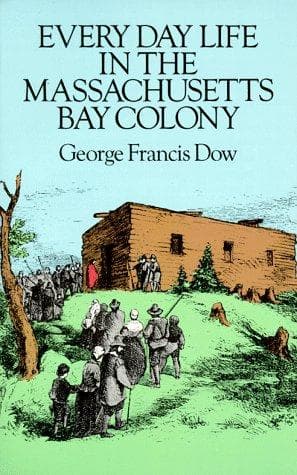
Every Day Life in the Massachusetts Bay ColonyDow, George Francis
History
Every Day Life in the Massachusetts Bay Colony
Dow, George Francis
Massachusetts -- Social life and customs -- To 1775
With such a background and burdened with such a far-reaching
antagonism toward the finer things of life, that help to lighten the
burden of existence and beautify the way, it is small wonder that
the esthetics found little fertile soil in New England; and much of
this prejudice and state of mind lingered among the old families in
the more remote and orthodox communities, until recent times.
The New England Puritans only allowed themselves one full holiday
in the course of the year and that was Thanksgiving Day, a time
for feasting. To be sure, there was Fast Day, in the spring,
which gave freedom from work; but that was a day for a sermon
at the meetinghouse, for long faces and a supposed bit of self
denial--somewhere. The celebration of Christmas was not observed
by the true New England Puritan until the middle of the nineteenth
century.
A number of sermons preached by Rev. Samuel Moodey, an eccentric
minister at York, Maine, for nearly half a century, were printed
and among them: "The Doleful State of the Damned, especially such
as go to hell from under the Gospel." This sermon was followed by
its antidote, entitled: "The Gospel Way of Escaping the Doleful
State of the Damned." Another of his sermons was upon "Judas the
Traitor, Hung up in Chains." Parson Moodey's son, Joseph, followed
him in the pulpit at York. He was known as "Handkerchief Moodey,"
as he fell into a melancholy; thought he had sinned greatly; and
after a time wore a handkerchief over his face whenever he appeared
in public. In the pulpit he would turn his back to the congregation
and read the sermon, but whenever he faced his people it would
be with handkerchief-covered features. Think what must have been
the influence of two such men on the life and opinions of a town
covering a period of two generations!
During the late seventeenth century and well into the eighteenth,
the books usually found in the average New England family were
the Bible, the Psalm Book, an almanac, the New England Primer, a
sermon or two and perhaps a copy of Michael Wigglesworth's terrific
poem--"The Day of Doom." The latter was first printed in 1662 in
an edition of 1800 copies not one of which has survived. Every
copy was read and re-read until nothing remained but fragments of
leaves. Seven editions of this poem were printed between 1662 and
1715 and few copies of any edition now exist. The book expressed
the quintesscence of Calvinism. Here is stanza 205, expressing the
terror of those doomed to hell:
"They wring their hands, their caitiff-hands,
and gnash their teeth for terrour:
They cry, they roar, for anguish sore
and gnaw their tongues for horrour.
But get away without delay,
Christ pities not your cry:
Depart to Hell, there may you yell,
and roar Eternally."
Public-domain text, read in full here on John Shaqi.
Reviews
Reviews
No reviews yet
Be the first to share your thoughts on this work.
Elsewhere in the archive
Join the Discussion
Join the discussion
Sign in to leave a comment or review.
Sign InorCreate an account