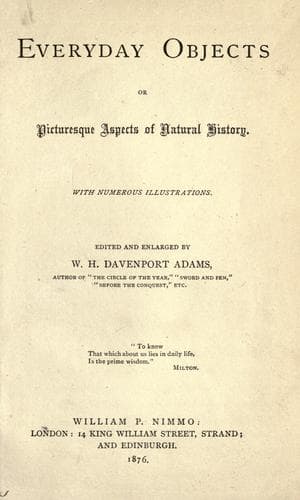
Everyday Objects; Or, Picturesque Aspects of Natural History.Adams, W. H. Davenport (William Henry Davenport)
History
Everyday Objects; Or, Picturesque Aspects of Natural History.
Adams, W. H. Davenport (William Henry Davenport)
Natural history
We have already, and more than once, employed the word _perianth_[58]
to designate the calyx or corolla, whether taken separately or
together. In the former case, the _perianth_ is _simple_; in the
latter, it is _double_. A more appropriate word could not be made use
of. It is derived from the Greek πεσὶ, around, and ἃνθος,
flower; and literally signifies, "floral envelope." Simple or double,
this envelope is the metamorphosis of several leaves, never of a
solitary one, inserted upon planes so closely brought together that
they seem confounded. Observe, in fact, how the leaves tend to efface
their intervals on the blossom-bearing spray; they draw towards each
other, they are apparently in eager haste to accomplish their destined
transformation. What eloquence there is in this simple language of
nature!
* * * * *
_The Calyx._--The outermost whorl, or verticle, of the flower is
called the _calyx_. And why? Out of a notion altogether incorrect.
It is true that this foliaceous envelope may often assume the shape
of a cup (in Latin, _calix_), and hence that the name has about it a
semi-poetical air. But this only occurs when the calyx is composed of
a _single_ leaf, which has procured for it the special designations
of _monosepalous_, _gamopetalous_, and _monophyllous_,--three
different words expressing one and the same thing! The violet and
the primrose are examples of a monophyllous, monosepalous, or
gamopetalous calyx.
I see, dear reader, that you are puzzled by the word _sepal_.
Certainly you would look for it in vain in any classical dictionary;
it is neither Greek nor Latin. It was only invented, scarce a century
ago, by a Swiss botanist, whose works have chiefly remained in
manuscript,--by Necker, brother of the celebrated minister of Louis
XVI., and uncle of the illustrious Madame de Staël. Let me explain
the circumstance which determined, I suspect, the choice of this
fanciful word,--a word belonging to no language but that of modern
botanists.
The botanists of antiquity called the coloured leaflets of the
corolla, _petals_. In this they were doubly right; for, first, they
are, in reality, nothing but metamorphosed leaves; second, the word
_petal_ (in Greek, πέταλον) signified "a leaf" as early as the days
of Homer, who, when speaking of the nightingale, says, like a keen
observer of nature, that this bird, on the return of spring, sings--
"Couched among the thick leaves of the grove."
(Δενδρέων ἐν πετάλοισι καθεζομένη
πυκινοῖσιν.)[59]
Public-domain text, read in full here on John Shaqi.
Reviews
Reviews
No reviews yet
Be the first to share your thoughts on this work.
Elsewhere in the archive
Join the Discussion
Join the discussion
Sign in to leave a comment or review.
Sign InorCreate an account