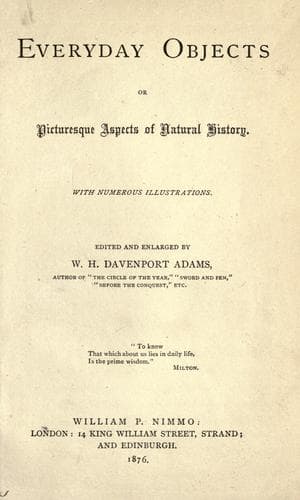
Everyday Objects; Or, Picturesque Aspects of Natural History.Adams, W. H. Davenport (William Henry Davenport)
History
Everyday Objects; Or, Picturesque Aspects of Natural History.
Adams, W. H. Davenport (William Henry Davenport)
Natural history
These peculiarities are useful in the distinction of certain species,
which, at bottom, are simply varieties. Thus, in the _Polygala
Austriaca_ (_Polygala amara_ of Keoch, _Polygala uliginosa_ of
Reichenbach),--a plant with small white or bluish leaves, which is
sometimes met with on the borders of peaty swamps,--the central vein
or ridge of the wings is simple, and never anastomoses with the
lateral veins; while, in the _Polygala vulgaris_, as well as in the
_Polygala depressa_ and _Polygala amarella_, the vein is ramified,
and anastomoses more or less widely with the laterals.
* * * * *
But since we are upon this subject, why should we not seize the
opportunity of familiarising ourselves, under the form of a
digression, with the little family of the Polygalaceæ? But no; we
will adjourn the episode, since it would cut the thread of our
discourse upon the calyx, our _calicology_.
* * * * *
Some calices there are, which, by their colouring, approximate so
closely to the second floral envelope, that one is always tempted to
call them corollas.
Such are:--The red calyx of the fuchsia;
The yellow calyx of the furze (_Ulex Europæus_), and of a kind of
hellebore (_Helleborus hyemalis_);
The rosy calyx of the Christmas rose (_Helleborus niger_);
The blue calyx of the larkspur (_Delphinium Ajacis_); and the Napel
aconite (_Aconitum Napellus_).
In the _Aquilegia vulgaris_, and in the _Trollius Europæus_, the
calyx, by the form and colouring of its leaflets, is confounded with
the second whorl so completely, that Linnæus gave it the name of
_corolla_.
Nevertheless, in the midst of these waverings, which lead us to
mistake the calicinal leaflets sometimes for bracts, sometimes for
petals, we recognise perfectly the foliaceous type. Independently
of its colour, which is generally green, the calyx has the same
organisation as the leaf; we find in it the same tracheæ and the
same stomata, the same glands and the same hairs; the veins and
ramifications are also the same; and, in more than one instance,
the calicinal leaflet resumes the character of a veritable leaf.
Look, for example, at the five leaflets, united so strongly at the
base but so free at the top, arranged in the form of a quincunx, of
the hundred-leaved rose. The two external, enlarged, and lanceolate
pieces are garnished on the right and left, and often at the point,
with tiny foliaceous appendages, which, in every respect, imitate the
composite leaf that carries the slender stem. And if we move aside
the external or bearded parts of the calyx, we see that the internal
bear less and less resemblance to a leaf. Thus, the part which
comes next is _semi-bearded_; that is to say, it is furnished with
foliaceous appendages only on one side; and the two upper pieces are
_beardless_, that is, reduced to the dilated central vein.
Public-domain text, read in full here on John Shaqi.
Reviews
Reviews
No reviews yet
Be the first to share your thoughts on this work.
Elsewhere in the archive
Join the Discussion
Join the discussion
Sign in to leave a comment or review.
Sign InorCreate an account