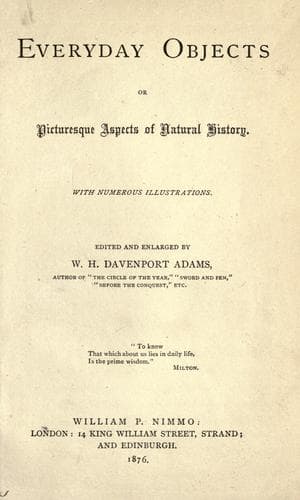
Everyday Objects; Or, Picturesque Aspects of Natural History.Adams, W. H. Davenport (William Henry Davenport)
History
Everyday Objects; Or, Picturesque Aspects of Natural History.
Adams, W. H. Davenport (William Henry Davenport)
Natural history
The calyx may change in consistency and texture in proportion as
the ovary, to which it adheres, changes into fruit. The fleshy
pulpy substance of the apple, and, in general, of the fruits of
the Pomaceæ, is simply an excessive development of the calicinal
tube united all around the ovary, and recognisable in the pips,
imprisoned, towards the centre, in horny lobes. In other plants, as
the flower develops into fruit, the calyx becomes woody: such is the
case with the Water Chestnut (_Trappa natans_).
Finally, the calyx may even contribute to the dissemination of the
seed. We may cite, as an example, a Brazilian species of Urticaceæ,
which Saint-Hilaire named the _Elasticaria_. The fleshy and
cylindrical parts of the calyx are curved inwards, and thus defend,
as one might do with one's bended fingers, the young fruit until it
is completely developed; as soon as the fruit is ripe, they spring up
erect, and launch it to a distance.
* * * * *
_The Corolla._--If from the circumference we proceed to the centre
of the flower, the calyx being the first, the _corolla_ will be its
second envelope.
If, on the contrary, we proceed from the centre to the circumference,
the corolla will form the fourth whorl; the pistil (consisting of
stigmata, stylus, and ovary) being the first; the nectariferous
disc (often wanting) the second; and the stamens the third whorl.
Remarkable for its varied tints, the corolla, to indifferent or
ignorant eyes, seems the entire flower.
A black or blackish colour is exceedingly rare. Out of 300 vegetable
species which compose the flora of Central Europe, there are not six
with blackish or even grayish flowers. No hypothesis has yet been put
forward to explain this mark-worthy rarity.
Species with a yellow corolla are the most numerous, forming more
than a sixth of the European flora: then come, in their order of
frequency, species with green, white, red, and blue flowers; the
white increasing in number as we approach the Pole.
Dividing the flora into twenty parts, we may ascribe to each colour,
and its various tints, the following proportion:--
Yellow, 6.0
Green, 4.50
White, 4.0
Red, 3.50
Blue, 1.50
Black, 0.50
The analogy between the parts or _petals_ of the corolla and the
leaf, is perhaps not quite so striking as between the leaf and the
_sepals_ of the calyx. The phrase "rose-leaves" is an expression
consecrated by immemorial usage. Why not prefer the term "corollary
leaves or leaflets (_foliola_)" to that of petals?
Public-domain text, read in full here on John Shaqi.
Reviews
Reviews
No reviews yet
Be the first to share your thoughts on this work.
Elsewhere in the archive
Join the Discussion
Join the discussion
Sign in to leave a comment or review.
Sign InorCreate an account