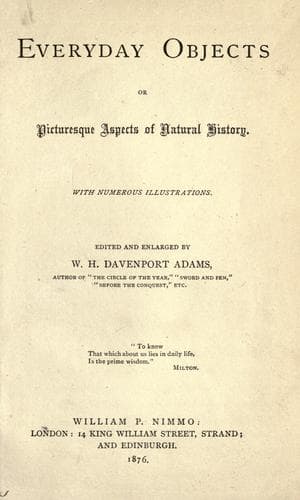
Everyday Objects; Or, Picturesque Aspects of Natural History.Adams, W. H. Davenport (William Henry Davenport)
History
Everyday Objects; Or, Picturesque Aspects of Natural History.
Adams, W. H. Davenport (William Henry Davenport)
Natural history
But it is scarcely less prized by the Hindus, who have also
consecrated it to one of their deities. A traveller thus speaks of
the sacred Ganges in connexion with it:--"The rich and luxuriant
clusters of the lotus float in quick succession upon the silvery
current. Nor is it the sacred lotus alone which embellishes the
wavelets of the Ganges; large white, yellow, and scarlet flowers
pay an equal tribute; and the prows of the numerous native vessels
navigating the stream are garlanded by long wreaths of the most
brilliant daughters of the parterre. India may be called a paradise
of flowers: the most beautiful lilies grow spontaneously upon the
sandy shores of the rivers, and from every projecting cliff some
shrub dips its flowers in the waters below."
No reader of English poetry but is familiar with Tennyson's
"Lotus-Eaters"--a poem founded on the old myth of a people who lived
upon the insane root that takes the reason prisoner, and, beguiled
by its sweet intoxication, abandoned themselves to a state of dreamy
repose.
"And round about the keel with faces pale,
Dark faces, pale against that rosy flame,
The mild-eyed, melancholy Lotus-eaters came.
"Branches they bore of that enchanted stem,
Laden with flower and fruit, whereof they gave
To each, but whoso did receive of them,
And taste, to him the gushing of the wave
Far, far away did seem to mourn and rave
On alien shores; and if his fellow spake,
His voice was thin, as voices from the grave;
And deep asleep he seemed, yet all awake,
And music in his ears his beating heart did make.
"They sat them down upon the yellow sand,
Between the sun and moon upon the shore;
And sweet it was to dream of Fatherland,
Of wife, and child, and slave; but evermore
Most weary seemed the sea, weary the oar,
Weary the wandering fields of barren foam.
Then some one said, 'We will return no more;'
And all at once they sang, 'Our island home
Is far beyond the wave; we will no longer roam.'"
But the lotus of poetry is not the _Nelumbium speciosum_. There
is some difficulty in identifying it with any modern plant; but
the general opinion seems to be, that it was the _Zizyphus lotus_,
a species allied to the _Zizyphus jujuba_, and included in the
Buckthorn family (_Rhamnaceæ_).
The reader will be by this time aware that of the plants called by
the general English name of "lily," some have very little kinship
to each other, and others none at all. The little garden flowers
named _Lilium_ (from the Celtic word _lis_, "whiteness") are mostly
very handsome. Ben Jonson, speaking of the ordinary lily, says, very
finely--
"It is not growing like a tree
In bulk, doth make man better be,
Or standing long, an oak, three hundred year,
To fall a log at last, dry, bald, and sear:
A lily of a day
Is fairer far in May,
Although it fall and die that night,--
It was the plant and flower of light."
Public-domain text, read in full here on John Shaqi.
Reviews
Reviews
No reviews yet
Be the first to share your thoughts on this work.
Elsewhere in the archive
Join the Discussion
Join the discussion
Sign in to leave a comment or review.
Sign InorCreate an account