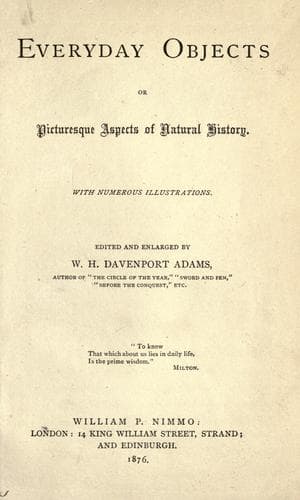
Everyday Objects; Or, Picturesque Aspects of Natural History.Adams, W. H. Davenport (William Henry Davenport)
History
Everyday Objects; Or, Picturesque Aspects of Natural History.
Adams, W. H. Davenport (William Henry Davenport)
Natural history
1. Gentiana verna.
2. Silena acaulis.
3. Draba frigida.[66]
4. Draba fladnizensis.
5. Cardamine bellidifolia.
6. Cardamine resedifolia.
7. Potentilla frigida.
8. Phyteuma hemisphericum.
9. Pyrethrum Alpinum.
10. Erigeron uniflorum.
11. Saxifraga bryoides.
12. Saxifraga Groenlandica.
13. Saxifraga muscoides.
14. Saxifraga oppositifolia.
15. Androsace Helvetica.
16. Androsace pubescens.
17. Lazula spicata.
18. Festuca Halleri.
19. Poa laxa.[67]
20. Poa cæsia.
21. Poa Alpina.
22. Trisetum subspicatum.
23. Agrostis rupestris.
24. Carex nigra (Cariceæ).
THE PIMPERNEL.
Accompany me to the corn-field; not for any discourse upon the state
and prospect of the crops, or on the comparative value to man of
wheat or barley, but for the sake of the little red flower which
shines like a star among the growing harvest.
You cannot mistake it, for, with the exception of the tiny
chaff-weed, the smallest wild plant which bears a distinct flower,
it is the only scarlet blossom in the wheat-field, except, indeed,
the red poppy, which every good farmer seeks to banish from his land.
Mark me,--I say the only _scarlet_ flower; for there are several--as,
for instance, the pheasant's eye, or Adonis--of a deep crimson.
The pimpernel belongs to the Primrose family, or Primulaceæ. It has
a five-cleft calyx, and a monopetalous corolla. Its stamens, of an
equal number, are inserted on the corolla, opposite its segments.
It is a _meteoric_ flower; so-called, because it keeps itself shut
during wet or cloudy weather. Hence, it is known among country people
as "the shepherd's warning" or "poor man's weather-glass." And
Darwin, enumerating the various signs of rain, says of it--
"Closed is the pink-eyed pimpernel;
In fiery red the sun doth rise,
Then wades through clouds to mount the skies:
'Twill surely rain, we see 't with sorrow;
No working in the fields to-morrow."
It should be added, however, that if the rain continue for several
days, the pimpernel will lose its sensibility, and cease to act as a
natural weather-glass.
And here we may observe, that singular as is the habit of the flowers
anticipating rain by folding their petals within their calices,
the way which the Siberian sow-thistle has with it is still more
curious. This plant, during that clear weather which most flowers
affect, keeps entirely shut; but as soon as a thick mist overspreads
the earth, or a cloud obscures the bright face of heaven, it begins
to open its light blue corolla.
Everybody knows, or should know, that when the robin looks sad and
drooping, and ceases to greet you with his wonted blithesome strain,
"foul weather" is at hand. Many animals, by their peculiar habits,
afford equally certain indications of approaching atmospheric changes.
Public-domain text, read in full here on John Shaqi.
Reviews
Reviews
No reviews yet
Be the first to share your thoughts on this work.
Elsewhere in the archive
Join the Discussion
Join the discussion
Sign in to leave a comment or review.
Sign InorCreate an account