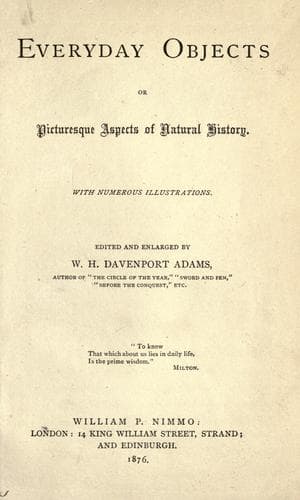
Everyday Objects; Or, Picturesque Aspects of Natural History.Adams, W. H. Davenport (William Henry Davenport)
History
Everyday Objects; Or, Picturesque Aspects of Natural History.
Adams, W. H. Davenport (William Henry Davenport)
Natural history
Moles are among the most prolific of mammals; and, in fact, were it
not so, their race would have been long ago exterminated. We may,
perhaps, venture to say, that by multiplying so prodigiously, they
wish to do us a service in spite of ourselves. How tender is the
solicitude of nature for the ungrateful human species!
To see the marvellous qualities ascribed to the mole by the ancients,
one would suppose that they had made him the object of their special
study. Yet, as we have shown, they could never have watched his
habits with any degree of patience. They saw everything through the
delusive prism of their imagination. As a proof, we will tell you
what they said of the mole.
"Since this animal has been doomed to a perpetual blindness, and
lives interred beneath the surface of the earth, like the dead, he
possesses, by way of compensation, some extraordinary qualities.
His subterranean existence renders him, of all animals, the most
capable of religion (_nullum religionis capacius animal_). To acquire
the gift of second-sight, you must eat the heart of a mole, while
still beating, and freshly plucked from the animal's body. To cure
toothache, suspend to your neck the tooth of a live mole. Lymphatic
people will gain in strength if sprinkled with a mole's blood. The
ashes of a mole are a sovereign remedy for scrofula; some recommend
for this disease the animal's liver, others the right foot, and
others the head. The earth of mole-hills, fashioned into pastilles,
and preserved in a tin box, is an excellent cure for all kinds of
tumours, and especially for abscesses on the neck."[70]
Such, according to Pliny's report, are the virtues of the mole, as
taught by the Magi. The Middle Ages adopted this teaching, and even
to-day, in obscure rural districts, you will meet with superstitious
notions which remind you of the ideas of the ancient wise men and
necromancers of antiquity.
We have thus summarised the natural history of our _hunter_, let us
now say a few words respecting the _game_ he pursues.
* * * * *
The insect before us is the _Staphylinus olens_. Its study has been
much neglected, probably on account of its repulsive appearance.
But, conquering our repugnance, let us take the creature between
our forefinger and thumb. See how vigorously it defends itself! Its
forked appendage is not formidable, it is too soft; but take care of
its mandibles! With these hard, horny, pointed pincers, it pricks the
skin and draws blood. Now, bring your nose close to the frightful
black insect at the very moment when it appears the most irritated.
Come! A little courage will conquer your new feeling of disgust.
What do you smell?
A pleasant odour of rennet apples! It reminds me of that diffused
by another insect, much less ugly than your _Staphylinus_, the
_Cicondela campestris_.
Public-domain text, read in full here on John Shaqi.
Reviews
Reviews
No reviews yet
Be the first to share your thoughts on this work.
Elsewhere in the archive
Join the Discussion
Join the discussion
Sign in to leave a comment or review.
Sign InorCreate an account